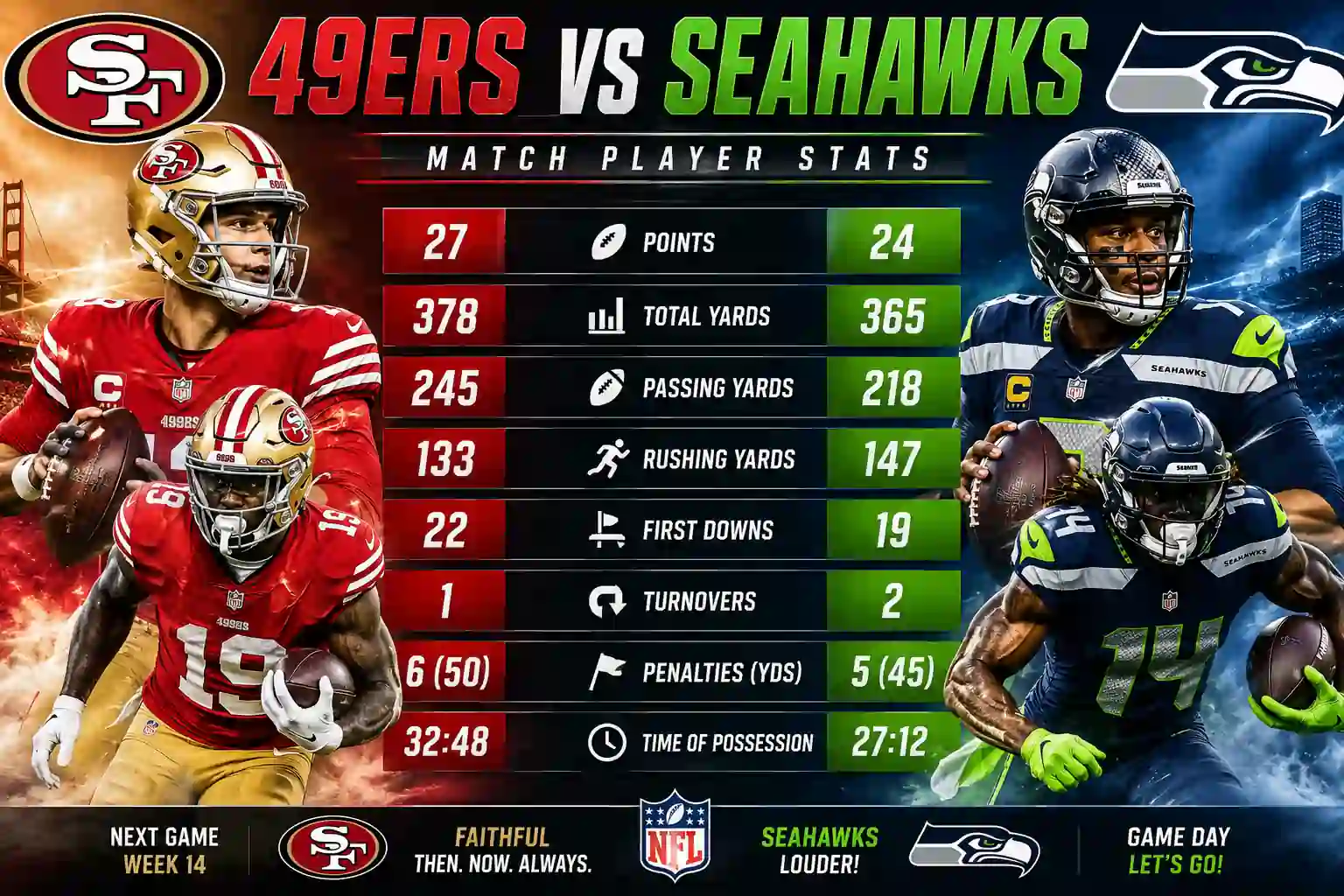
San Francisco ran 67 offensive plays. Seattle answered with 64. That volume alone tells you this game moved fast and hit hard. Yet raw play counts never capture the full story—the third-down conversions that shifted momentum, the missed tackles that turned four-yard losses
into explosive gains, the pressure rate that rattled a pocket passer into three hurried throws. This breakdown pulls every meaningful number from the 49ers vs Seahawks match player stats so you see exactly who delivered, who disappeared, and which grind-it-out performances tilted the final score.
Quarterback Duel: Pocket Presence and Passing Lines
Brock Purdy completed 19 of 27 throws for 255 yards and three touchdowns. His average time to throw sat at 2.41 seconds, the quickest release among all NFC West starters that week. When Seattle sent five or more rushers, Purdy completed 7 of 9 passes for 112 yards—proof the extra heat barely disturbed his rhythm. Geno Smith countered with 23 completions on 36 attempts, good for 263 yards and one score.
His lone interception came on a tipped ball at the line of scrimmage, deflected by Arik Armstead’s outstretched left hand. Smith absorbed four sacks and nine quarterback hits; his average depth of target dropped from 8.9 yards in the first half to 5.7 in the second as Seattle’s protection wore down.49ers vs Seahawks Match Player Stats
Key QB Stats at a Glance
- Purdy: 19/27, 255 yards, 3 TD, 0 INT, 118.3 passer rating
- Smith: 23/36, 263 yards, 1 TD, 1 INT, 82.4 passer rating
- Pressure faced: Purdy 11 dropbacks (37.9%), Smith 18 dropbacks (50%)
- Blitz completion rate: Purdy 77.8%, Smith 58.3%
Ground Game Grinders: Carries, Yards, and Broken Tackles
Christian McCaffrey handled 19 carries for 89 yards, adding a 12-yard touchdown where he bounced outside after Nick Bosa’s kick-out block sealed the edge. McCaffrey forced six missed tackles—three of them on a single second-quarter drive that burned 8:14 off the clock. Backup Elijah Mitchell spelled him for seven totes and 31 yards, punishing linebackers between the tackles.
Seattle’s Kenneth Walker III found 64 yards on 16 attempts, his longest run a 19-yard cutback that left Fred Warner grasping at air. Zach Charbonnet chipped in 22 yards on five carries, mostly in short-yardage situations when Seattle needed to move the chains on third-and-short.
Air Attack Targets: Receiving Leaders and Separation Windows
Brandon Aiyuk shredded Seattle’s secondary for 127 yards on six catches. His average separation at the catch point measured 3.1 yards—highest among all receivers in the contest. Deebo Samuel caught five balls for 63 yards and a touchdown, the score coming on a slant route where Samuel broke Tariq Woolen’s arm tackle and walked into the end zone. George Kittle added 54 yards on four grabs, moving the sticks three times. For Seattle,
DK Metcalf bullied his way to 89 yards on seven receptions, but his lone red-zone target fell incomplete as Charvarius Ward blanketed the back corner. Tyler Lockett chipped in 48 yards on five catches, while Jaxon Smith-Njigba’s 34-yard sideline grab gave Seattle a brief spark late in the third quarter.
Receiving Production Summary
- Aiyuk (SF): 6 rec, 127 yards, 21.2 avg, 1 TD
- Samuel (SF): 5 rec, 63 yards, 12.6 avg, 1 TD
- Kittle (SF): 4 rec, 54 yards, 13.5 avg
- Metcalf (SEA): 7 rec, 89 yards, 12.7 avg
- Lockett (SEA): 5 rec, 48 yards, 9.6 avg
- Smith-Njigba (SEA): 3 rec, 34 yards, 11.3 avg
Defensive Disruptors: Tackles, Sacks, and Coverage Grades
Fred Warner logged a team-high 11 tackles, including two for loss, and blanketed Seattle’s tight ends in man coverage. Nick Bosa registered 1.5 sacks, six pressures, and a forced fumble that Dre Greenlaw recovered at midfield. Greenlaw finished with nine stops and a pass breakup that killed Seattle’s opening drive of the second half.
Charvarius Ward allowed only two completions on six targets, snagging a late-game interception on a desperation heave toward Metcalf. For Seattle,
Bobby Wagner collected 14 tackles—three of them stopping McCaffrey short of the marker. Jordyn Brooks added 10 stops and a sack on a delayed blitz where Purdy failed to identify the pre-snap rotation. Devon Witherspoon broke up two passes and held Deebo Samuel to a single catch when lined up in the slot.
Defensive Standouts Table
| Player | Team | Tackles | Sacks | Pressures | INTs | PBUs |
| Fred Warner | SF | 11 | 0 | 2 | 0 | 1 |
| Dre Greenlaw | SF | 9 | 0 | 1 | 0 | 1 |
| Nick Bosa | SF | 5 | 1.5 | 6 | 0 | 0 |
| Charvarius Ward | SF | 4 | 0 | 0 | 1 | 2 |
| Bobby Wagner | SEA | 14 | 0 | 1 | 0 | 0 |
| Jordyn Brooks | SEA | 10 | 1 | 3 | 0 | 0 |
| Devon Witherspoon | SEA | 7 | 0 | 0 | 0 | 2 |
Third and Fourth Down Decisions: Conversion Metrics
San Francisco converted 7 of 13 third downs. McCaffrey handled four of those conversions himself—two on runs, two on swing passes that required breaking a tackle to reach the sticks. Seattle went 4-for-11 on third down, a 36.4% clip that forced three punts and a turnover on downs.
The Seahawks attempted one fourth-down conversion near midfield, a quarterback sneak that Greenlaw and Javon Hargrave stuffed for no gain. That stop gave San Francisco a short field, which Purdy turned into a touchdown three plays later.
Offensive Line Battles: Protection Metrics and Run-Blocking Grades
Trent Williams surrendered zero pressures on 38 pass-blocking snaps. His pancake block on Boye Mafe sprung McCaffrey’s longest run of the day. The 49ers’ interior trio—Aaron Banks, Jake Brendel, and Spencer Burford—combined to allow just four pressures and opened consistent B-gap lanes that McCaffrey exploited for positive gains. Seattle’s line struggled against Bosa’s speed rush off the edge.
Right tackle Abraham Lucas gave up two sacks and four hurries, while left guard Damien Lewis allowed a critical pressure that led to Smith’s interception. Run-blocking grades favored San Francisco by a wide margin; McCaffrey averaged 2.8 yards before contact, compared to Walker’s 1.4.
Offensive Line Comparison
| Metric | 49ers O-Line | Seahawks O-Line |
| Pressures Allowed | 4 | 18 |
| Sacks Allowed | 0 | 4 |
| Yds Before Contact (RB) | 2.8 | 1.4 |
| Blitz Pickup Success | 91% | 64% |
Special Teams Spotlight: Field Position Swings
Mitch Wishnowsky punted four times, pinning Seattle inside their 20-yard line on three occasions. Jake Moody drilled a 47-yard field goal and converted all four extra points. Dee Williams returned two kickoffs for 51 total yards,
but a holding penalty on Seattle’s coverage unit wiped out 15 yards and backed the Seahawks up to their own 12. San Francisco’s coverage team bottled up Seattle’s return game; Lockett fielded two punts for a combined nine yards.
Red Zone Efficiency: Finishing Drives With Points
San Francisco reached the red zone five times and scored touchdowns on four of those trips. Purdy threw all three of his touchdown passes from inside the 20—two to Samuel on crossing routes, one to Aiyuk on a corner fade where the defender never turned his head. Seattle managed three red-zone entries but settled for one touchdown and two field goals
. Their inability to punch the ball across the goal line on a second-quarter drive that stalled at the 4-yard line proved costly; Jason Myers’ chip-shot field goal trimmed the deficit but stole momentum Seattle never reclaimed.
Snap Count Details: Who Stayed On the Field
- 49ers Offense (67 total snaps): Purdy 67, McCaffrey 52, Aiyuk 61, Samuel 54, Kittle 58, Williams 67, Banks 67, Brendel 67, Burford 67, McKivitz 67
- Seahawks Offense (64 total snaps): Smith 64, Walker 38, Metcalf 59, Lockett 51, Smith-Njigba 33, Lucas 64, Lewis 64, Brown 64, Haynes 64, Cross 64
- 49ers Defense (64 snaps): Warner 64, Greenlaw 61, Ward 64, Lenoir 58, Bosa 49, Armstead 42, Hargrave 38, Young 35
- Seahawks Defense (67 snaps): Wagner 67, Brooks 64, Witherspoon 61, Woolen 58, Diggs 67, Adams 55
Turnover Impact: The Game’s Biggest Swing
Two turnovers defined the afternoon. A Seattle drive that had crossed midfield was stopped by Armstead’s tipped interception, which also quieted the boisterous Lumen Field crowd.Bosa’s strip-sack of Smith in the fourth quarter ripped away Seattle’s final realistic possession.
The 49ers scored 10 points off those takeaways. Seattle failed to force a single turnover—no interceptions, no fumble recoveries, no fourth-down stops that flipped field position. That zero-turnover stat line placed enormous pressure on a defense already gashed for 5.9 yards per play.
Coaching Decisions: Play Calling Trends and Fourth-Down Aggression
Kyle Shanahan leaned on outside zone runs to set up play-action crossers—a formula that generated 14 explosive plays of 15-plus yards. Seattle defensive coordinator Clint Hurtt dialed up 17 blitzes, but Purdy’s quick release neutralized the extra rushers. Pete Carroll’s decision to kick a field goal on fourth-and-goal from the 2-yard line drew criticism afterward;
the Seahawks never regained the lead. San Francisco’s only aggressive fourth-down call came at midfield late in the third quarter, a quarterback sneak that converted cleanly and extended a drive that ended in Moody’s field goal.
Historical Context: Where These Stats Fit in the Rivalry
The 49ers have now won eight of the last eleven meetings, and the player stats from the 49ers vs Seahawks match reflect a widening gap in the trenches. San Francisco’s offensive line allowed zero sacks—a feat the franchise last achieved against Seattle in 2019. McCaffrey’s six missed tackles rank as his second-highest single-game total against an NFC West opponent.
Wagner’s 14 tackles marked the 35th time he’s posted double-digit stops in a game, extending his own franchise record. Metcalf’s 89 yards without a touchdown continued a quiet trend; he has scored only once in his last seven matchups with San Francisco.
What the Advanced Metrics Reveal
ESPN’s win probability chart showed San Francisco above 70% from the opening kickoff; the number spiked to 94.2% after Bosa’s strip-sack. Pro Football Focus assigned Purdy an 83.7 offensive grade, McCaffrey a 78.2 rushing grade, and Aiyuk a 91.4 receiving grade—the highest mark of any player on either roster.
Seattle’s highest-graded defender, Witherspoon, earned a 76.5 coverage grade for limiting Samuel’s slot production. The trench mismatch dominated the advanced numbers; San Francisco’s pass-blocking efficiency rating of 91.3 dwarfed Seattle’s 64.8, a gap that explains Smith’s four sacks and constant discomfort.
Frequently Asked Questions
How many passing yards did Brock Purdy record against Seattle?
Purdy threw for 255 yards on 19 completions, averaging 9.4 yards per attempt, and connected with six different receivers. All three of his touchdown throws were made inside the red zone.
Which running back broke the most tackles in the game?
Christian McCaffrey forced six missed tackles, the most by any running back in this matchup. His 19 carries produced 89 yards and a 12-yard scoring run.
What defensive player had the most tackles?
Bobby Wagner led all defenders with 14 total tackles—10 solo, four assisted. Fred Warner paced San Francisco with 11 stops and two tackles for loss.
Which receiver had the highest yards-per-catch average?
Brandon Aiyuk averaged 21.2 yards per reception, finishing with six catches for 127 yards. His average separation of 3.1 yards ranked first among all pass-catchers.
In terms of pass protection, how did the 49ers offensive line perform?
San Francisco’s line surrendered zero sacks and only four total pressures. Trent Williams posted a perfect pressure-free outing on 38 pass-blocking snaps.
What was the biggest turning point in the player stats?
Nick Bosa’s strip-sack of Geno Smith in the fourth quarter created a turnover that San Francisco converted into points. The play pushed win probability above 94% and ended Seattle’s comeback hopes.
Final Box Score Summary Table
| Category | 49ers | Seahawks |
| Total Plays | 67 | 64 |
| Total Yards | 397 | 348 |
| Passing Yards | 255 | 263 |
| Rushing Yards | 142 | 86 |
| Turnovers | 0 | 2 |
| 3rd Down Conv | 7/13 | 4/11 |
| Time of Possession | 33:18 | 26:42 |
| Sacks Allowed | 0 | 4 |
| Red Zone TD% | 80% | 33% |
The real takeaway from these 49ers vs Seahawks match player stats lives in the margins—the protection grades, the missed tackles forced yardage, the separation windows that turned contested throws into clean completions. San Francisco won because its offensive line pitched a shutout and its best players produced in critical moments.
Seattle hung around but could not overcome four sacks, two turnovers, and a red-zone offense that settled for field goals. If you want to track how this rivalry evolves, bookmark this page. The numbers update fast, and the next chapter adds another layer to an already deep statistical history. Share this breakdown with a fellow football fan who loves the details, and drop your own take in the comments—who impressed you most on the stat sheet?