Eagles vs. Cowboys: The Complete History of the NFC East’s Bitterest Rivalry
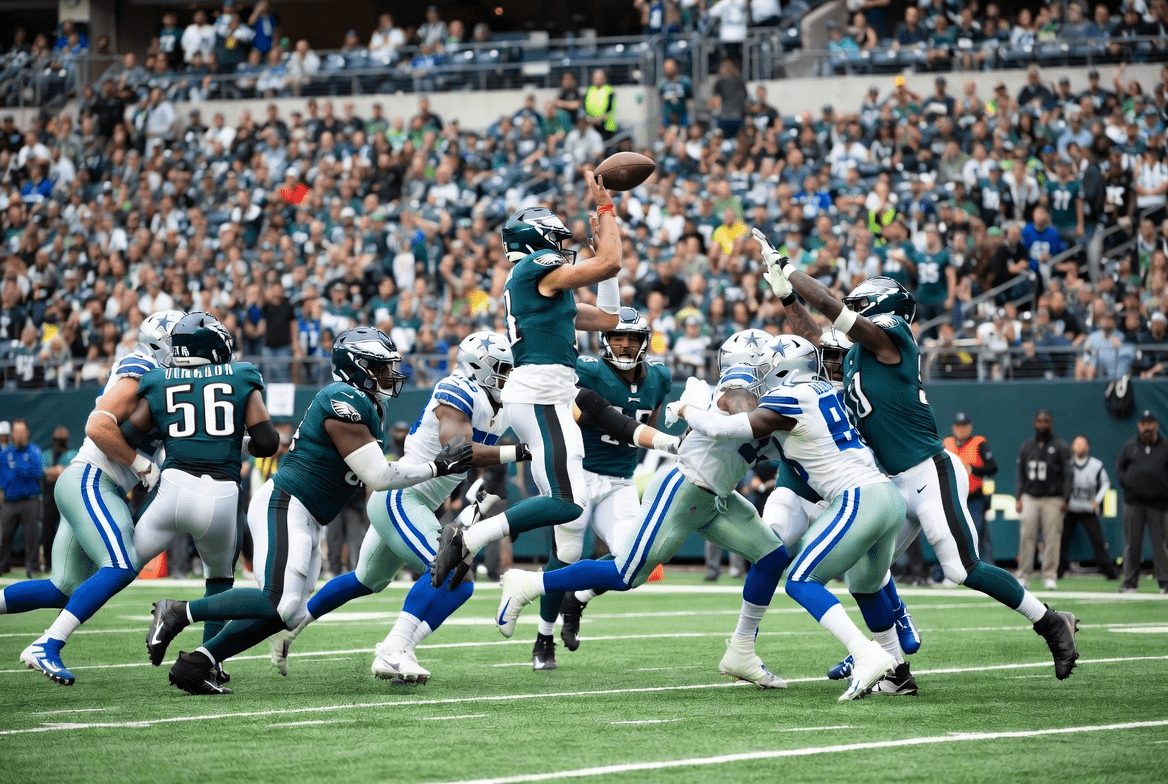
There are divisional matchups in the National Football League, and then there is the Philadelphia Eagles versus the Dallas Cowboys. Twice a year, regardless of the standings, this matchup demands national attention. It is a collision of two completely different football cultures: the glittering, high-profile spectacle of Dallas against the gritty, hostile, blue-collar intensity of Philadelphia.
This rivalry is not just about proximity. It is built on decades of playoff eliminations, accusations of bounties, snowballs thrown at opposing benches, stolen superstar players, and outright public disdain between head coaches.
Whether you are a lifelong fan looking to relive the glory days or a newcomer trying to understand why these two fanbases absolutely despise each other, this is the definitive history of the Eagles vs. Cowboys rivalry.
The All-Time Series Record: By the Numbers
Before diving into the narrative, the debate over who has the historical upper hand must be settled with facts.
As of the conclusion of the 2025 season, the Dallas Cowboys lead the all-time series with a combined regular-season and playoff record of 75-59.
While the Eagles have narrowed the gap significantly in the 21st century, the Cowboys built a massive lead during the first two decades of the rivalry. However, when the lights are brightest in January, Dallas holds a 3-1 advantage in the postseason. Despite the Cowboys’ overall edge in wins, Philadelphia claims arguably the most important head-to-head victory in the rivalry’s history: the 1980 NFC Championship game, which sent the Eagles to their first Super Bowl and signaled a permanent shift in the power dynamic of the NFC East.
The Origins of Animosity: How the Bad Blood Began (1960s–1970s)
The rivalry did not start with immediate fireworks. When the Dallas Cowboys entered the league as an expansion franchise in 1960, the Eagles actually won the NFL Championship that same year. In fact, Philadelphia won the first three matchups against Dallas. But the tide turned rapidly.
Under the legendary leadership of head coach Tom Landry, the Cowboys transformed into a football machine. With his trademark fedora and stoic demeanor, Landry engineered a system that consistently dismantled the Eagles. From 1967 to 1972, Dallas beat Philadelphia 11 consecutive times. From 1974 to 1978, they ripped off another nine-game winning streak.
During the 1970s, Dallas became a dynasty. They won two Super Bowls, made five appearances, and earned the moniker “America’s Team.” The national media adored them. They had the iconic star on the helmet, the cheerleaders, and the flashy playmakers.
In Philadelphia, resentment boiled over. Eagles fans grew sick of watching their team serve as a punching bag for the darlings of the NFL. The hatred for Dallas was born out of sheer frustration. Philadelphia was a tough, working-class city that prided itself on resilience, and they despised everything the shiny, corporate Dallas Cowboys stood for.
The Turning Point: The 1980 NFC Championship
The dynamic of the rivalry fundamentally changed on January 11, 1981.
Head coach Dick Vermeil had slowly rebuilt the Eagles into a physical, punishing football team. In the 1980 season, the Eagles finally matched the Cowboys’ dominance, winning the NFC East and setting up a showdown with Dallas in the NFC Championship Game at Veterans Stadium.
Understanding the psychological warfare of the rivalry, the Eagles made a brilliant uniform decision. As the home team, Philadelphia chose to wear their white road jerseys. This forced the Cowboys into their blue jerseys. In Dallas lore, the blue jerseys were considered cursed—a belief stemming from their Super Bowl V loss.
The strategy worked, but it was the physical play of the Eagles that sealed the game. On the second play from scrimmage, Eagles running back Wilbert Montgomery broke through the line for a 42-yard touchdown in front of a deafening Philadelphia crowd. The Eagles defense battered Dallas quarterback Danny White, forcing turnovers and suffocating the Cowboys’ offense.
Philadelphia won 20-7, securing their first trip to the Super Bowl and finally slaying the dragon that had tormented them for two decades. The Cowboys were no longer invincible.
Buddy Ryan, Jimmy Johnson, and the Bounty Bowls (1989)
If 1980 brought competitive balance to the rivalry, 1989 brought pure, unadulterated hatred.
The Eagles were now led by defensive mastermind Buddy Ryan, a brash, unapologetic coach who built one of the most terrifying defenses in NFL history, anchored by Reggie White and Jerome Brown. The Cowboys, meanwhile, were undergoing a painful rebuild under first-year head coach Jimmy Johnson.
The hostility peaked on Thanksgiving Day 1989 in a game famously dubbed “Bounty Bowl I.” The Eagles annihilated the Cowboys 27-0 in Texas. During the game, Cowboys kicker Luis Zendejas (a former Eagle) was knocked out by a vicious blindside hit, and quarterback Troy Aikman was relentlessly targeted. After the game, Jimmy Johnson took to the podium and accused Buddy Ryan of placing financial bounties on Zendejas and Aikman. Ryan dismissed the accusations with utter contempt, famously quipping that he would have done better on his diet if he had the money Johnson claimed he was handing out.
The rematch in Philadelphia two weeks later, “Bounty Bowl II,” was pure chaos. Energized by the bounty accusations and fueled by pre-game tailgating, the Veterans Stadium crowd was hostile. As the Eagles secured a 20-10 victory, fans rained snowballs, ice, and beer down onto the field, targeting the Dallas bench, Jimmy Johnson, and even the broadcast booth. The game cemented the national narrative of Philadelphia’s feral fanbase and permanently etched the Dallas-Philadelphia matchup as the most toxic rivalry in the sport.
The 1990s and 2000s: Playoff Stakes, Pickle Juice, and Blowouts
The 1990s saw Dallas return to prominence, winning three Super Bowls and dominating the early part of the decade behind Troy Aikman, Emmitt Smith, and Michael Irvin. But by the turn of the millennium, Philadelphia hired Andy Reid, drafting Donovan McNabb and assembling a roster that would rule the NFC East for the next decade.
The 2000 Pickle Juice Game
In the 2000 season opener, the Eagles traveled to Texas Stadium. The on-field temperature was a blistering 109 degrees. Anticipating the brutal heat, Eagles trainer Rick Burkholder had the players drink pure pickle juice before the game, theorizing that the high sodium content would prevent cramping. The bizarre strategy worked flawlessly. While the Cowboys wilted in the heat, the Eagles flew around the field, executing an onside kick to open the game and routing Dallas 41-14.
The Terrell Owens Saga
The rivalry escalated to soap-opera levels in the mid-2000s regarding Hall of Fame wide receiver Terrell Owens. T.O. helped lead the Eagles to a Super Bowl appearance in 2004, but a bitter contract dispute and highly publicized feud with Donovan McNabb led to his release. Where did Owens go? Directly to the Dallas Cowboys. The sight of Owens catching passes with a star on his helmet infuriated Philadelphia. When Owens returned to Philly as a Cowboy in 2006, the atmosphere was electric, but the Eagles got the last laugh, intercepting Drew Bledsoe and winning the game 38-24.
The 44-6 Elimination Game (2008)
Few regular-season games in NFL history carry the weight of the 2008 regular-season finale. Both teams entered Week 17 needing a win, coupled with losses by other teams, to secure a wild-card playoff spot. By kickoff at Lincoln Financial Field, the external scenarios had miraculously fallen into place. It was a simple “win-and-in” scenario. The loser would go home.
What was expected to be a tight, tense battle turned into one of the most famous beatdowns in Philadelphia sports history. The Eagles defense mercilessly pressured Tony Romo, forcing turnovers and returning fumbles for touchdowns. The Eagles hung 44 points on the Cowboys, allowing only 6. Philadelphia eliminated their biggest rival from playoff contention on national television and rode that momentum all the way to the NFC Championship game.
The Modern Era: Prescott, Hurts, and NFC East Supremacy
As the rivalry transitioned into the 2010s and 2020s, the faces changed, but the stakes remained identical.
In 2013, the two teams met in Week 17 in a winner-take-all game for the NFC East crown. With Tony Romo injured, backup Kyle Orton led Dallas on a late drive, only to throw a game-sealing interception to Eagles cornerback Brandon Boykin, giving Philadelphia a 24-22 win and the division title.
Today, the rivalry is defined by the quarterback duel between Philadelphia’s Jalen Hurts and Dallas’s Dak Prescott. Over the last several seasons, the two teams have continuously swapped the NFC East crown. No team has won the NFC East in back-to-back years in two decades, largely because the Eagles and Cowboys constantly cannibalize each other’s championship aspirations.
In recent years, the matchups have remained as physical and unpredictable as ever. In 2024, the Eagles dominated the season series, sweeping the Cowboys with decisive victories, including a 41-7 thrashing in late December. However, 2025 proved the rivalry is never one-sided for long. The teams traded blows once again, with the Eagles securing a tight 24-20 opening week victory, only for the Cowboys to extract revenge with a 24-21 win in Week 12.
Every time these two teams step onto the field, the modern stars—from Saquon Barkley and A.J. Brown to Micah Parsons and CeeDee Lamb—are acutely aware that a loss in this specific game weighs far heavier than any other game on the schedule.
Why the Eagles-Cowboys Rivalry Will Never Die
Many rivalries in professional sports fade when one or both teams experience a down decade. The Eagles and Cowboys do not have this problem. They are the financial and cultural anchors of the NFC East.
The Cultural Clash: America’s Team vs. The Underdogs
At its core, this rivalry is a proxy war between two distinct American identities. The Dallas Cowboys brand themselves with unparalleled bravado. They are the most valuable sports franchise on the planet. They play in a billion-dollar stadium featuring a massive video board. They expect glamour, media attention, and prime-time slots.
Philadelphia embraces the exact opposite identity. The city thrives on a complex of being overlooked and underappreciated. The fanbase demands maximum effort above all else. They do not care about glitz; they care about grit. Eagles fans relish the role of the spoiler, finding deep, visceral joy in tearing down the pristine image that the Cowboys project to the world.
There is no mutual respect to be found in the stands at AT&T Stadium or Lincoln Financial Field. There is no polite applause for a good play by the opposition. When the Eagles and Cowboys line up against each other, it is sixty minutes of historical resentment, divisional stakes, and unabashed hatred. And that is exactly what makes it the greatest rivalry in professional football.