Introduction
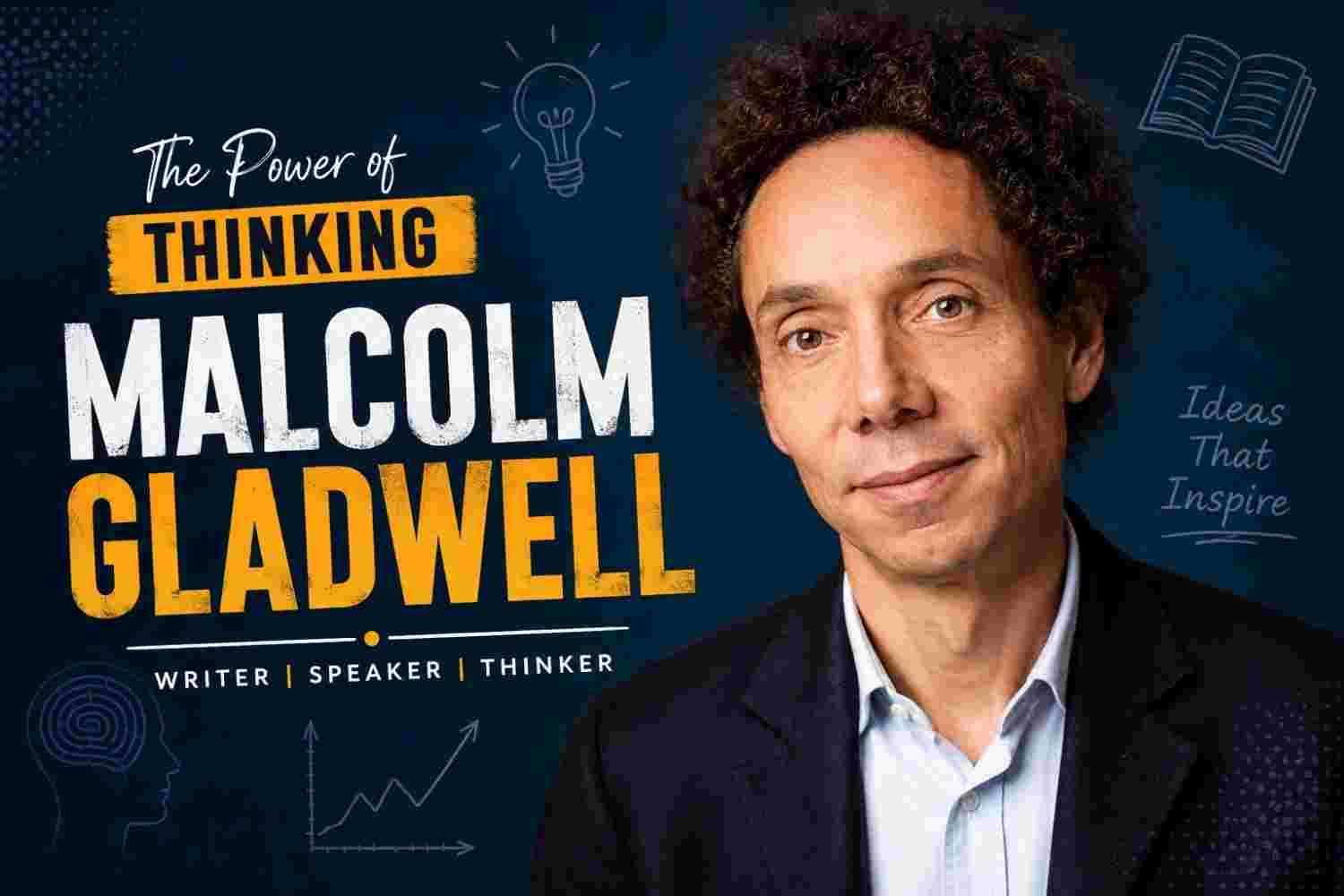
The world is not as simple as it seems. Patterns hide in plain sight, and the stories we tell ourselves often miss the real point. Malcolm Gladwell has built a career on finding these hidden patterns and presenting them in a way that is both surprising and accessible. He translates complex social science into gripping narratives that make us rethink success, influence, and human behavior . His work is a masterclass in connecting with an audience, making him one of the most influential thinkers of our time.
Who is Malcolm Gladwell?
Malcolm Gladwell is a British-born Canadian journalist, author, and public speaker. He has been a staff writer for The New Yorker since 1996 . His background is not in a specific social science but in history, a degree he earned from the University of Toronto . This outsider perspective is key to his appeal. He approaches psychology and sociology as a curious investigator, asking questions that experts might overlook. He has been named one of Time magazine’s 100 Most Influential People .
His work is defined by the “adventure of ideas,” a term he uses to describe his narrative style. He doesn’t just present facts; he builds stories around them, making the data come alive. By minimizing the distance between his conversational voice and his writing, Gladwell creates a sense of intimacy with the reader, as if they are having a fascinating conversation at a party .
Understanding The Tipping Point
The concept of the tipping point is what first brought Malcolm Gladwell to global prominence. He defines it as the “magic moment when an idea, trend, or social behavior crosses a threshold, tips, and spreads like wildfire” . It is the point at which a small change has a massive, exponential impact. This metaphor, borrowed from epidemiology, suggests that ideas and products can spread like viruses.
Gladwell argues that three key types of people are crucial to sparking a social epidemic: Connectors, Mavens, and Salesmen .
- Connectors are the social hubs of their networks, knowing many people across different social circles.
- Mavens are information specialists who accumulate knowledge and are eager to share it with others.
- Salesmen are the charismatic persuaders who have the skills to convince others to adopt a new idea.
Together, these three groups can create a powerful word-of-mouth epidemic that transforms a product or idea from obscurity to a phenomenon.
The Power of “Thin-Slicing” in Blink
If The Tipping Point is about how ideas spread, Blink is about how we process them. The central theme of Blink is “thin-slicing,” the idea that our unconscious mind can make remarkably accurate decisions based on very limited information . It’s the power of thinking without thinking.
Gladwell explores how these snap judgments, made in the blink of an eye, are often more reliable than long, rational deliberation. He uses fascinating examples, from art experts instantly recognizing a forgery to marriage counselors predicting divorce by analyzing a short video clip of a couple. He argues that these rapid assessments are influenced by our experiences and subconscious biases, which can both help and hinder us. The key is to understand when to trust our gut and when to be wary of its hidden prejudices .
Debunking the 10,000-Hour Rule from Outliers
One of Malcolm Gladwell‘s most famous and controversial concepts is the “10,000-Hour Rule,” popularized in his book Outliers: The Story of Success . This rule suggests that achieving true mastery in any complex field requires roughly 10,000 hours of dedicated practice. The idea was based on research by psychologist Anders Ericsson on violinists and chess players.
However, the rule is often misunderstood. Gladwell did not claim that anyone could become a world-class expert by simply clocking in 10,000 hours. Instead, he argued that this level of practice is a prerequisite for mastery, but it must be accompanied by significant opportunity, such as being born in the right place at the right time . A 2025 study even challenged the “10000-Hour Rule,” suggesting that late bloomers often succeed through multidisciplinary exploration rather than early specialization . This highlights a key part of Gladwell’s framework: success is rarely a solo achievement. It is heavily influenced by cultural legacies and unearned advantages, demonstrating how the “rich get richer,” a principle he connects to the biblical Matthew Effect .
The Storytelling Philosophy of Malcolm Gladwell
Malcolm Gladwell is an expert storyteller. His philosophy on writing is as influential as his social theories. He believes that writing should feel like a conversation, making even dense academic concepts relatable. His core advice is simple: “Don’t write. Speak into a tape recorder and then transcribe it. That is your first draft” . This helps a writer find their authentic voice.
He emphasizes the importance of stories over anecdotes. An anecdote is a small example, but a story frames an entire idea. It allows the reader to become invested in a narrative while they ponder the bigger concept. He also advises writers to resist the urge to be comprehensive. Pick one or two key ideas to communicate, and make them stick. The goal is not to answer every question but to leave the audience thinking .
Core Theories and Concepts
Malcolm Gladwell has introduced many powerful concepts that have entered the cultural lexicon. Here is a look at some of his most influential ideas.
| Theory/Concept | Key Book | Core Idea |
| The Tipping Point | The Tipping Point | That magic moment when a trend or idea crosses a threshold and spreads like wildfire . |
| The Law of the Few | The Tipping Point | Social epidemics are driven by a small group of exceptional individuals: Connectors, Mavens, and Salesmen . |
| The Stickiness Factor | The Tipping Point | A message’s power to be memorable and impactful, like the lessons in Sesame Street . |
| Thin-Slicing | Blink | The ability of our unconscious mind to make fast, accurate decisions based on narrow slices of experience . |
| The 10,000-Hour Rule | Outliers | Achieving mastery in a field takes roughly 10,000 hours of practice, but only with opportunity and access . |
| The Matthew Effect | Outliers | The principle that the rich get richer and the successful get more success, creating an “accumulative advantage” . |
| The Power of Context | The Tipping Point | Human behavior is deeply influenced by the environment and circumstances, as seen in the fall of crime in NYC . |
| Overstory & Superspreaders | Revenge of the Tipping Point | New frameworks for understanding how cultural norms and a few highly influential figures shape society . |
The Revisionist History Podcast
Beyond his books, Malcolm Gladwell has expanded his reach through the highly successful podcast Revisionist History. In each episode, he re-examines a person, event, or idea from the past that he believes has been overlooked or misunderstood . The show is an extension of his core philosophy: that the past deserves a second chance and that our understanding of history is often shaped by incomplete narratives. It offers a platform for Gladwell to continue his “adventure of ideas” in an audio format, encouraging listeners to question accepted truths. He has also hosted other podcasts like Broken Record with Rick Rubin, further cementing his influence in the podcasting world .
Criticisms and Controversies
Malcolm Gladwell is not without his critics. Some academics and social scientists have accused him of oversimplifying complex ideas, cherry-picking data to fit his narrative, and making broad generalizations from small case studies . His work has been described as pop-sociology that feels “bloated and insubstantial” in book form by some reviewers .
For example, his “10,000-Hour Rule” has come under fire from some of the very researchers it was based on, who felt Gladwell misrepresented their work. Critics also point out his tendency to present speculative ideas as fact. Despite these criticisms, his ability to make complex topics accessible and engaging is undeniable. Even his critics acknowledge that he succeeds in creating a captivating narrative that gets people thinking .
The Legacy and Future Impact of Malcolm Gladwell
Malcolm Gladwell has fundamentally changed how we communicate ideas. He has made social science a topic of dinner table conversation. More than just an author, he is an intellectual brand and a “goldmine of big ideas” . His impact is seen in business schools, marketing strategies, and the way leaders think about persuasion and culture.
With his latest book, Revenge of the Tipping Point, he revisits his earlier work, rethinking the mechanics of social epidemics for a more complex world by introducing new concepts like “overstories” and “superspreaders” . This willingness to evolve his thinking shows a commitment to the ideas themselves, not just a single theory. Malcolm Gladwell’s true legacy is his relentless curiosity and his gift for turning research into irresistible stories. His work remains a blueprint for how to communicate ideas in a crowded world.
Frequently Asked Questions
What is Malcolm Gladwell’s most famous book?
While all of his books are bestsellers, The Tipping Point: How Little Things Make a Big Difference is generally considered his most famous. It introduced the world to his unique style of storytelling and his ability to explain social phenomena in a memorable way .
Is Malcolm Gladwell a scientist?
No, Malcolm Gladwell is a journalist and author. He is not a scientist, but a popularizer of scientific ideas. He is known for his ability to translate complex research from psychology and sociology into accessible and engaging narratives for a general audience .
What is the “10,000-Hour Rule”?
The “10,000-Hour Rule,” popularized by Gladwell in Outliers, suggests that you need about 10,000 hours of dedicated practice to achieve mastery in a complex skill. However, the rule is often oversimplified; Gladwell also emphasizes that opportunity and timing are critical factors for success .
Where can I listen to Malcolm Gladwell’s podcasts?
His main podcast is Revisionist History, which is available on major platforms like Apple Podcasts and Spotify. He also co-hosts Broken Record, a music podcast with Rick Rubin .
Has Malcolm Gladwell’s “10,000-Hour Rule” been proven wrong?
Recent research has challenged the “10,000-Hour Rule,” suggesting that success can also come from broad, multidisciplinary exploration, especially in childhood. This indicates that early specialization, which the rule seems to encourage, isn’t the only path to becoming a world-class expert .
What is the main message of Malcolm Gladwell’s work?
Gladwell’s work encourages us to challenge our assumptions. He shows us that hidden patterns, subtle influences, and unexpected contexts often shape our world more than we realize. His central message is that to understand why things happen, we must look beyond the obvious and often question the accepted narrative.
Conclusion
Malcolm Gladwell stands as a master of re-framing the ordinary. He encourages us to look at the world with fresh eyes, to question our snap judgments, and to understand the hidden forces that shape our lives. Whether you agree with his conclusions or not, his unique ability to weave social science into captivating stories has changed the way a generation thinks about success, influence, and human behavior. His work is a call to action: to be curious, to question the status quo, and to find the adventure in ideas. We invite you to revisit his classic works, tune into his podcast, and keep your mind open to the tipping points all around you.