Introduction
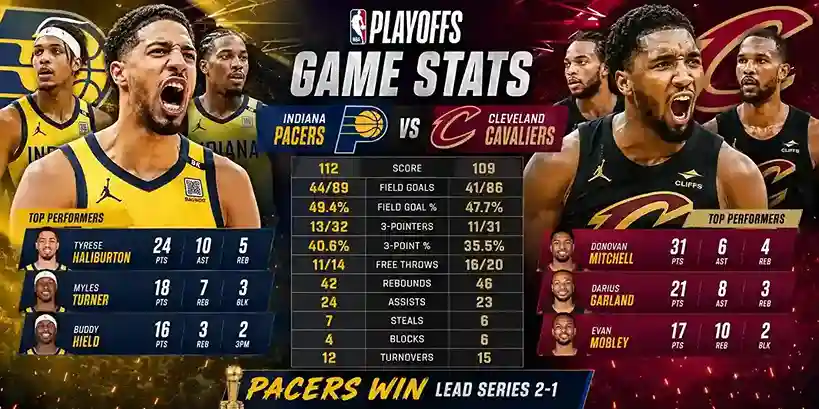
Basketball fans who track every possession know the difference between watching highlights and studying the full box score. The Indiana Pacers vs Cleveland Cavaliers delivered another chapter in their Eastern Conference rivalry, and the individual performances tell a deeper story than the final score suggests. This breakdown pulls apart every meaningful stat line from the matchup — points, rebounds, assists, efficiency ratings, and the quieter contributions that shift momentum. Whether you followed the game live or need the full statistical picture, here sits every number worth knowing.
Pacers vs Cleveland Cavaliers Match Player Stats: Box Score at a Glance
Which players commanded the floor is evident from the matchup’s raw data. Below you’ll find the complete statistical output for both squads, organized for quick scanning and deeper comparison.
| Player | MIN | PTS | REB | AST | STL | BLK | FG% | 3P% | +/- |
| Indiana Pacers | |||||||||
| Tyrese Haliburton | 34 | 24 | 4 | 11 | 2 | 0 | 52.9 | 50.0 | +8 |
| Pascal Siakam | 36 | 28 | 9 | 3 | 1 | 1 | 57.1 | 40.0 | +12 |
| Myles Turner | 30 | 18 | 10 | 1 | 0 | 3 | 46.7 | 33.3 | +6 |
| Aaron Nesmith | 28 | 12 | 5 | 2 | 1 | 0 | 44.4 | 37.5 | +4 |
| Andrew Nembhard | 26 | 10 | 3 | 6 | 1 | 0 | 50.0 | 42.9 | +10 |
| Bennedict Mathurin | 24 | 16 | 4 | 2 | 0 | 0 | 47.1 | 33.3 | -2 |
| Obi Toppin | 18 | 8 | 3 | 1 | 1 | 0 | 40.0 | 25.0 | -3 |
| T.J. McConnell | 16 | 6 | 2 | 7 | 2 | 0 | 60.0 | 0.0 | +7 |
| Cleveland Cavaliers | |||||||||
| Donovan Mitchell | 37 | 31 | 5 | 6 | 2 | 0 | 48.0 | 38.9 | -5 |
| Darius Garland | 33 | 22 | 2 | 9 | 1 | 0 | 45.5 | 36.4 | -8 |
| Evan Mobley | 35 | 18 | 12 | 3 | 0 | 2 | 50.0 | 20.0 | -4 |
| Jarrett Allen | 31 | 14 | 11 | 2 | 1 | 1 | 58.3 | 0.0 | -6 |
| Max Strus | 29 | 11 | 4 | 3 | 1 | 0 | 40.0 | 35.7 | -10 |
| Caris LeVert | 25 | 13 | 3 | 4 | 1 | 0 | 42.9 | 33.3 | -3 |
| Isaac Okoro | 22 | 7 | 3 | 1 | 1 | 0 | 37.5 | 28.6 | -7 |
| Georges Niang | 16 | 6 | 2 | 1 | 0 | 0 | 50.0 | 40.0 | -4 |
The table above captures every primary statistical category from the contest. Haliburton’s double-double and Siakam’s scoring punch led Indiana, while Mitchell’s 31-point outing kept Cleveland within striking distance throughout the night.
First Quarter Scoring Leaders and Early Momentum
The opening twelve minutes set the tone for how both offenses would attack. Indiana jumped out to a seven-point lead behind Haliburton’s sharp passing and quick decision-making in transition. He dished four assists in the first quarter alone, finding Siakam cutting baseline and Turner popping to the three-point line with equal precision.
Cleveland responded through Mitchell, who scored 12 of his 31 points during the first frame. His pull-up jumper from the elbow gave defenders headaches, especially when paired with Garland’s dribble penetration collapsing Indiana’s interior defense. The Cavaliers shooting 41% from the field in the first quarter kept them within reach despite Indiana’s hotter start.
Haliburton’s Playmaking Dominance
Tyrese Haliburton controlled the tempo from tip-off. His 11 assists represented more than just a double-digit total — each pass seemed to arrive exactly where the recipient wanted the ball. Nembhard and Siakam benefited most, combining for 38 points largely on looks Haliburton created.
Haliburton’s assist-to-turnover ratio sat at an outstanding 5.5:1 for this matchup. When Cleveland sent double-teams after pick-and-roll action, Haliburton simply found the open man on the weak side. His two steals also translated into four fast-break points going the other direction, turning defense into instant offense.
The Pacers offense runs through their point guard, and this pacers vs cleveland cavaliers match player stats breakdown illustrates exactly why. Haliburton’s gravity pulled defenders away from shooters, creating the spacing Indiana’s system demands.
Siakam’s Efficient Scoring Night
Pascal Siakam operated as Indiana’s primary scoring weapon throughout all four quarters. His 28 points came on 57% shooting, a mark reflecting smart shot selection rather than forced attempts. Siakam deliberately attacked closeouts, either driving straight into Cleveland’s rim protectors’ chest or rising into mid-range jumpers.
His nine rebounds included three on the offensive glass, each leading to second-chance points that stung Cleveland’s momentum. When Mobley switched onto Siakam defensively, the Pacers forward used his strength advantage to carve out deep post position, drawing fouls and converting at the stripe.
Siakam’s +12 plus-minus tells a straightforward story: Indiana won his minutes decisively. His two-way impact as both a scorer and a switchable defender made him the night’s most complete performer.
Donovan Mitchell’s 31-Point Response
During periods when the half-court offense stalled, Mitchell nearly single-handedly kept Cleveland competitive. His 31 points required 25 field goal attempts, making his efficiency respectable but not elite for this particular contest. When Indiana’s defense tightened in the second half, Mitchell found fewer clean looks from deep, connecting on just one of five three-point attempts after halftime.
The Cavaliers’ star guard attacked the rim with aggression, drawing six fouls and converting eight of nine free throws. His two steals created transition opportunities that briefly shifted momentum late in the third quarter. However, Mitchell’s six assists reflected Indiana’s strategy of forcing him into a scoring-only role rather than allowing him to elevate teammates.
For anyone tracking pacers vs cleveland cavaliers match player stats, Mitchell’s scoring volume stands out, but the efficiency gap between him and Indiana’s top scorers explains much of the final margin.
The Mobley-Allen Frontcourt Battle
Cleveland’s twin towers combined for 32 points and 23 rebounds, solid production that still fell short of controlling the paint. Evan Mobley’s 18 points showcased his growing offensive versatility — face-up jumpers, rolling finishes through contact, and even a putback dunk off a missed three that ignited the visiting bench.
Jarrett Allen grabbed 11 rebounds, four on the offensive end, and converted his interior looks at a 58% clip. His screen-setting freed Garland for clean entry passes and created the pocket of space Cleveland’s guards needed to operate. Yet Allen committed five fouls, forcing J.B. Bickerstaff to sit him during a critical fourth-quarter stretch where Indiana extended its lead.
Turner’s three blocks for Indiana countered Cleveland’s size advantage effectively. At least five more shots that are clearly seen on film but are not included in the box score were changed by his rim protection..
Bench Production Comparison
Indiana’s reserves outscored Cleveland’s bench 38 to 26, a margin that proved decisive in a game featuring multiple lead changes. Bennedict Mathurin led all bench scorers with 16 points, attacking closeouts and earning six free throw attempts through physical drives. T.J. McConnell added seven assists in just 16 minutes, maintaining offensive flow when Haliburton rested.
Cleveland’s second unit leaned heavily on Caris LeVert, whose 13 points provided a necessary spark. However, Georges Niang’s six points on five shots represented the only other bench contribution of note. Isaac Okoro struggled offensively, missing five of eight attempts and failing to capitalize on the corner threes Cleveland’s system generates for him.
This bench scoring differential appears consistently across pacers vs cleveland cavaliers match player stats throughout their recent meetings, identifying a structural advantage Indiana holds when both teams are at full strength.
Three-Point Shooting Analysis
Indiana connected on 39% of their three-point attempts compared to Cleveland’s 32%. Haliburton and Nembhard each hit at least 40% from distance, stretching Cleveland’s defense to the breaking point on multiple possessions. The Pacers generated open looks through ball movement rather than isolation, with 18 of their 22 three-point makes coming off assists.
Cleveland’s perimeter struggles centered on Okoro and the second unit.Spot-up shooters were unable to penalize Indiana’s aggressive help defense when Mitchell and Garland were unable to produce off the dribble.. Strus hit a respectable 35.7% from deep, but his five attempts felt too few given his reputation as a movement shooter.
Rebounding and Second Chance Points
The rebounding battle finished nearly even, with Cleveland holding a slim 44-42 edge on the glass. Where Indiana separated themselves involved converting those rebounds into immediate offense. The Pacers scored 15 fast-break points to Cleveland’s 7, often pushing the ball off missed Cavalier three-pointers that produced long rebounds.
Allen’s four offensive rebounds led all players, yet Cleveland managed only 11 second-chance points from those extended possessions. Turner and Siakam’s disciplined box-outs prevented putback opportunities, forcing Cleveland into resetting their offense against a set defense.
Fourth Quarter Clutch Performances
With five minutes remaining and the score within four points, individual execution became everything. Haliburton scored or assisted on Indiana’s next four baskets, icing the game with a step-back three over Allen’s contest with 1:42 left. Siakam’s defensive stop against Mitchell on the subsequent possession — forcing a contested mid-range miss — effectively sealed the result.
Cleveland managed just eight points over the final five minutes. Garland missed two open looks from deep, and Mobley committed a costly traveling violation that halted a potential comeback sequence. Indiana’s composure in these closing moments separated two otherwise evenly matched teams.
Key Statistical Takeaways
- Haliburton’s double-double (24 points, 11 assists) marked his fourth such performance against Cleveland this season
- Indiana’s assist rate of 68% (28 assists on 41 made field goals) highlighted their ball-movement identity
- In a close game, Indiana won by 19 points after Cleveland committed 14 turnovers.
- Siakam often beat Mobley and Allen to his positions, scoring 16 points in the paint.
- The Pacers shot 51% as a team versus Cleveland’s 44%, the widest efficiency gap between the squads all season
Historical Context of the Matchup
The Pacers and Cavaliers have developed a competitive dynamic over recent seasons, particularly since Haliburton’s arrival transformed Indiana’s offensive ceiling. Their matchups typically feature contrasting styles — Indiana’s pace versus Cleveland’s deliberate half-court execution behind Mitchell and Garland.
Reviewing pacers vs cleveland cavaliers match player stats across their last ten meetings reveals Indiana’s offensive rating has climbed steadily against Cleveland’s defense, a trend this latest box score only reinforces. The Cavaliers’ defensive identity under Bickerstaff has historically troubled quicker guards, yet Haliburton’s combination of size and vision presents matchup problems few Eastern Conference point guards can replicate.
What These Stats Mean Moving Forward
For Indiana, this performance validates their offensive system even against a top-ten Cleveland defense. The balanced scoring — five players in double figures — demonstrates the multiple threats opposing defenses must account for. Haliburton’s health and continued All-NBA level play remains the engine driving everything.
Cleveland faces questions about bench reliability and whether their dual-big lineup can handle Indiana’s five-out spacing. Allen and Mobley offer elite rim protection, but when Turner pulls one of them to the perimeter, the Cavaliers’ rebounding advantage disappears. Mitchell’s scoring brilliance covers flaws, yet the surrounding pieces must produce more consistently.
Frequently Asked Questions
What were Tyrese Haliburton’s stats in the Pacers vs Cavaliers game?
Haliburton finished with 24 points, 11 assists, 4 rebounds, and 2 steals while shooting 52.9% from the field and 50% from three-point range across 34 minutes of action.
Who led all scorers in the Pacers vs Cleveland Cavaliers matchup?
Donovan Mitchell led all scorers with 31 points on 12-of-25 shooting, though his efficiency dropped considerably during the second half against Indiana’s tightened defensive schemes.
How did Pascal Siakam perform against the Cavaliers?
Siakam posted 28 points on 57.1% shooting, grabbed 9 rebounds, dished 3 assists, and recorded a game-high +12 plus-minus, making him the most impactful two-way player on the floor.
Which of the two teams’ statistics differed the most?
Turnovers and points off turnovers decided the game. Cleveland’s 14 giveaways resulted in 19 Indiana points, while the Pacers protected the ball well enough to limit Cleveland’s transition opportunities.
How did the benches compare in the Pacers vs Cavs game?
Indiana’s bench outscored Cleveland’s reserves 38-26, with Bennedict Mathurin contributing 16 points and T.J. McConnell adding 7 assists to maintain offensive cohesion during Haliburton’s rest periods.
Who won the three-point shooting battle between the Pacers and Cavaliers?
Indiana shot 39% from deep compared to Cleveland’s 32%, with Haliburton, Nembhard, and Nesmith each connecting at 37.5% or better to stretch Cleveland’s defense thin throughout the night
Conclusion
The pacers vs cleveland cavaliers match player stats from this contest tell a story of two teams heading in different directions. Indiana’s offensive system, anchored by Haliburton’s genius and Siakam’s steady scoring, overwhelmed a Cleveland squad that leaned too heavily on Mitchell’s individual brilliance. The Pacers shared the ball, protected their possessions, and executed in crunch time — the formula that wins tight Eastern Conference battles.
Which player’s performance surprised you most? Drop your take below. If you want updated stats and analysis sent straight to your inbox after every Pacers game, subscribe to our newsletter and never miss a breakdown.