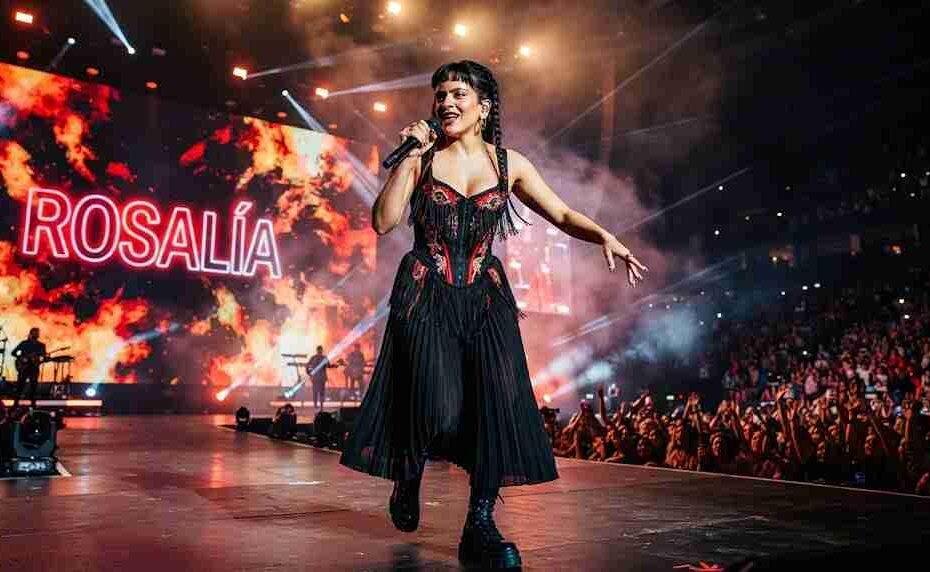
Picture a tiny girl in Sant Esteve Sesrovires, a quiet town outside Barcelona, mimicking flamenco hand claps she heard drifting from a neighbor’s stereo. That girl grew up to sell out arenas on five continents and reshape what pop music sounds like in the 2020s.
If you have been anywhere near social media lately, rosalía is impossible to ignore. Her latest collaborations keep breaking streaming records, her red-carpet looks dominate fashion headlines, and fans are buzzing about a rumored new album cycle. The timing feels perfect to pull back the curtain on everything that makes this artist one of the most fascinating figures in modern music.
So grab your cafecito. We are going deep into the life, the money, and the creative fire behind one of Spain’s greatest cultural exports.
The Early Years: Where It All Started for Rosalía
Rosalía Vila Tobella was born on September 25, 1992, in Sant Cugat del Vallès, Catalonia, Spain. Her family was not connected to the music industry in any traditional sense. Her father worked in the auto-parts business, and her mother managed a family restaurant. Music was simply something that lived in the walls of their home.
By age seven, rosalía was already obsessed with the rhythms of flamenco. She would sit cross-legged on the living room floor, replaying Camarón de la Isla records until the vinyl practically wore thin. Her parents noticed the fixation early and enrolled her in local music classes.
At thirteen, she entered the Taller de Músics in Barcelona, a respected school known for training serious young talent. She studied under José Miguel Vizcaya, better known as Chiqui de la Línea, a legendary flamenco cantaor who recognized something rare in her voice. He pushed her hard. She later said those years were the most demanding of her life.
By the time she finished her formal training at the Catalonia College of Music (ESMUC), rosalía had already performed at small tablaos and local festivals across Catalonia. She was not famous yet, but anyone who heard her sing knew she carried a weight far beyond her years.
Table of Contents
The Breakthrough: Los Ángeles and El Mal Querer
Her debut album, Los Ángeles, dropped in 2017. It was a stripped-down, almost ghostly collection of traditional flamenco reinterpreted through a modern lens. Critics in Spain praised it, but the project barely registered outside the Iberian Peninsula. That was about to change in a massive way.
In 2018, rosalía released El Mal Querer. The concept album was actually her university thesis project, which makes its success even more absurd. Built around a 13th-century Occitan novel about a toxic love affair, the record fused flamenco palmas with trap beats, autotune, and experimental production.
The single “Malamente” went nuclear. The music video, shot on the outskirts of Barcelona with local street culture imagery, racked up millions of views in days. Suddenly, rosalía was not just a Spanish artist. She was a global conversation.
El Mal Querer won the Latin Grammy for Album of the Year in 2019. She became the first solo female artist to take that prize since Shakira. The moment cemented her status as a generational talent and opened doors to collaborations with artists like J Balvin, Travis Scott, and Billie Eilish.
Motomami: The Era That Changed Everything
If El Mal Querer announced rosalía to the world, Motomami kicked the door off its hinges. Released in March 2022, the album was a chaotic, brilliant collision of reggaeton, jazz, bachata, flamenco, and hyperpop. It sounded like nothing else on the charts.
Tracks like “Saoko” and “Despechá” became instant anthems. “Despechá” in particular exploded on TikTok, spawning thousands of dance challenges and pushing rosalía into mainstream pop consciousness in a way her earlier work had not quite achieved.
The Motomami World Tour followed, spanning over 40 dates across Europe, Latin America, and North America. She performed at Coachella, Lollapalooza, and Primavera Sound to massive crowds. Reviews were ecstatic. Pitchfork gave the album a 9.2, one of the highest scores they had awarded in years.
This era also marked a significant shift in her brand partnerships. She signed deals with Nike, Skims, and Coca-Cola, dramatically increasing her income streams beyond music royalties and touring revenue.
Rosalía Net Worth: The Full Financial Breakdown
Let us talk numbers, because the financial picture is genuinely impressive for someone who only broke through globally around 2018.
As of 2025, rosalía’s estimated net worth sits between $12 million and $15 million. That figure comes from multiple revenue channels, and it is growing fast.
Music Royalties & Streaming: Her catalog generates tens of millions of streams monthly across Spotify, Apple Music, and YouTube. “Despechá” alone has surpassed 800 million streams on Spotify. Royalty checks from a catalog that size are substantial.
Touring Revenue: The Motomami World Tour grossed an estimated $25–30 million before expenses. Her upcoming tour dates are expected to push that number even higher, especially with stadium-level demand in Latin American markets.
Brand Endorsements: Deals with Nike, Skims, and luxury fashion houses like Rick Owens and Givenchy reportedly bring in seven figures annually. She is not just a face on a billboard — she co-designs capsule collections, which means she earns on the backend too.
Publishing & Songwriting Credits: Rosalía writes or co-writes nearly all of her material. That means she collects publishing royalties that many pop artists miss out on when they rely heavily on outside writers.
| Income Source | Estimated Annual Earnings |
| Streaming & Royalties | $2–3 million |
| Touring & Live Shows | $5–8 million (tour years) |
| Brand Deals & Endorsements | $2–4 million |
| Publishing & Songwriting | $1–2 million |
| Merchandise & Collabs | $500K–1 million |
Biography Table: The Key Milestones
| Year | Milestone |
| 1992 | Born in Sant Cugat del Vallès, Catalonia, Spain |
| 2005 | Begins formal flamenco training at Taller de Músics |
| 2013 | Enrolls at ESMUC (Catalonia College of Music) |
| 2017 | Releases debut album Los Ángeles |
| 2018 | Drops El Mal Querer and “Malamente” goes viral |
| 2019 | Wins Latin Grammy for Album of the Year |
| 2020 | Collaborates with Travis Scott on “TKN” |
| 2022 | Releases Motomami, wins multiple Grammy Awards |
| 2023 | Completes Motomami World Tour to critical acclaim |
| 2024–2025 | Teases new music, expands brand partnerships |
Profile Table: Personal Details
| Detail | Info |
| Full Name | Rosalía Vila Tobella |
| Date of Birth | September 25, 1992 |
| Birthplace | Sant Cugat del Vallès, Spain |
| Nationality | Spanish |
| Height | 5’5″ (165 cm) |
| Genres | Flamenco, Pop, Reggaeton, Experimental |
| Labels | Columbia Records, Sony Music |
| Languages | Spanish, Catalan, English |
| Notable Awards | 11 Latin Grammys, 2 Grammys |
Style, Influence, and the Cultural Conversation
You cannot talk about rosalía without addressing the cultural debate that has followed her since day one. As a Catalan artist working primarily within flamenco — a tradition rooted in Andalusian Romani culture — she has faced criticism about cultural appropriation from some corners of the Spanish music community.
She has addressed this directly in interviews, expressing deep respect for the tradition and crediting her teachers, particularly Chiqui de la Línea, for guiding her understanding of the art form. Whether that response satisfies every critic is a separate discussion, but it is a conversation she has never dodged.
What is undeniable is her influence on the broader pop landscape. Artists like Dua Lipa, Olivia Rodrigo, and Doja Cat have all cited rosalía as an inspiration for pushing genre boundaries. Her production choices — layering industrial noise over bulería rhythms, for instance — have become a blueprint for a new wave of experimental Latin pop.
Her fashion impact is equally significant. The motorcycle-meets-flamenco aesthetic of the Motomami era influenced runway collections and street style globally. Red carpet appearances in custom Rick Owens and vintage Mugler have made her a favorite of fashion editors from Vogue to Dazed.
Album Comparison: How Each Era Stacks Up
| Album | Release Year | Genre Blend | Key Singles | Streaming Peak | Critical Score (Avg) |
| Los Ángeles | 2017 | Traditional Flamenco / Acoustic | “Catalina,” “De Plata” | Moderate (Spain) | 7.5/10 |
| El Mal Querer | 2018 | Flamenco / Trap / Pop | “Malamente,” “Pienso en tu mirá” | 1.2B+ streams | 8.8/10 |
| Motomami | 2022 | Reggaeton / Jazz / Hyperpop / Flamenco | “Saoko,” “Despechá,” “Bizcochito” | 4B+ streams | 9.2/10 |
What Fans and Industry Insiders Are Saying
The reaction to rosalía’s trajectory has been overwhelmingly positive, though not without nuance. Music producers like Pharrell Williams and James Blake have publicly praised her ear for arrangement. Blake, who collaborated with her on “Barefoot in the Park,” called her “one of the most instinctive musicians I have ever worked with.”
Fan communities on Reddit and Twitter dissect every teaser clip she posts, often generating millions of impressions before any official announcement drops. The “Motomami” subreddit alone has over 100,000 active members who analyze her lyrics, choreography, and visual symbolism with academic-level intensity.
Industry analysts point to her as a case study in how non-English-language artists can achieve global dominance without diluting their cultural identity. She sings primarily in Spanish, refuses to anglicize her name, and still sells out Madison Square Garden. That blueprint is reshaping how record labels think about international A&R strategy.
Where Does She Go From Here?
Rosalía has accomplished more in seven years than most artists manage in a lifetime. She took a centuries-old musical tradition, dragged it into the future, and made the entire world pay attention. The money is impressive, the awards are staggering, and the cultural footprint is undeniable.
But the most interesting question is not about numbers or trophies. It is about what she does next. With a new album cycle on the horizon and her creative ambitions clearly expanding into fashion, film, and visual art, the next chapter could be her most unpredictable yet.
What era of rosalía is your personal favorite — the raw flamenco of Los Ángeles, the dark romance of El Mal Querer, or the chaotic brilliance of Motomami? Drop your pick in the comments and let us argue about it.