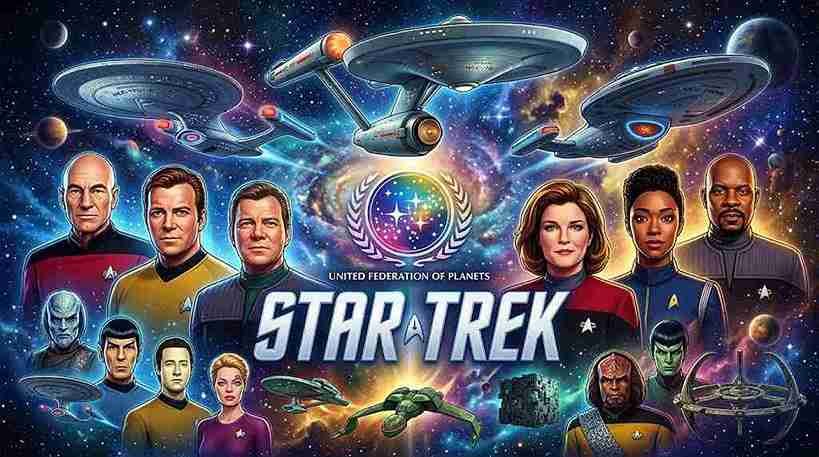
Imagine a future where humanity has conquered war, poverty, and prejudice — and explores the galaxy from the bridge of a gleaming starship. That bold vision launched Star Trek into orbit back in 1966, and nearly six decades later, the franchise commands a valuation that rivals the GDP of small nations.
Streaming wars, a wave of new spinoffs, and one of the most fiercely loyal fanbases in entertainment history have pushed Star Trek back into the cultural spotlight in a massive way. If you’ve ever wondered how a scrappy NBC show that barely survived three seasons turned into a multi-billion-dollar juggernaut, you’re in the right place. Let’s break down the full life story and the jaw-dropping net worth behind the franchise.
The Origin Story: How Star Trek Was Born From Rejection
Every great empire starts with a scrappy underdog story, and Star Trek is no exception. In the early 1960s, a former WWII pilot and LAPD officer named Gene Roddenberry pitched a wild idea to Hollywood executives. He wanted to create a science fiction show set in the 23rd century that used space exploration as a metaphor for real-world social issues.
Networks laughed him out of the room. CBS passed because they already had Lost in Space. NBC took a chance but demanded heavy changes. Roddenberry’s original pilot, “The Cage,” was considered “too cerebral” for mainstream audiences. Most producers would have walked away. Roddenberry rewrote, recast, and fought for a second pilot — a rarity in television at the time.
That second pilot, “Where No Man Has Gone Before,” finally convinced NBC to greenlight the series. William Shatner stepped in as Captain James T. Kirk, Leonard Nimoy stayed on as the half-Vulcan Spock, and the USS Enterprise was ready for its maiden voyage. Star Trek premiered on September 8, 1966, to modest ratings and a passionate but small audience.
Table of Contents
The Cancellation That Almost Killed the Franchise
Here’s the part that shocks most casual fans. The original Star Trek series was cancelled after just three seasons. Ratings were mediocre, the budget was enormous for the era, and NBC was ready to pull the plug as early as season two.
What saved the show — temporarily — was one of the first organized fan campaigns in television history. Bjo Trimble, a superfan, orchestrated a letter-writing blitz that flooded NBC with over a million pieces of mail. The network blinked and ordered a third season, though they buried the show in the dreaded Friday night “death slot.”
By 1969, it was over. Or so everyone thought.
The Syndication Miracle: How Star Trek Came Back From the Dead
The real life story of Star Trek doesn’t start on NBC. It starts in syndication. After cancellation, local TV stations across the US began airing reruns in the early 1970s. Something remarkable happened. The audience exploded. College students, science enthusiasts, and counterculture kids discovered the show and turned it into a cultural phenomenon.
Conventions started popping up. The first major Star Trek convention in 1972 drew 3,000 fans — organizers had expected 500. By 1974, that number swelled to 15,000. Paramount, which had acquired the rights through its Desilu Studios purchase, suddenly realized they were sitting on a goldmine.
This syndication boom directly led to Star Trek: The Animated Series in 1973, a short-lived but beloved continuation featuring the original voice cast. More importantly, it laid the groundwork for the franchise’s massive expansion in the decades to come.
The Film Era and the TNG Revolution
Paramount launched the first Star Trek feature film, Star Trek: The Motion Picture, in 1979. It was expensive, slow-paced, and received mixed reviews. But it grossed $139 million worldwide, proving the franchise had serious box office legs.
The real game-changer arrived in 1982 with Star Trek II: The Wrath of Khan. Directed by Nicholas Meyer on a tight budget, it delivered one of the most emotionally devastating scenes in cinema history — the death of Spock. The film was a critical and commercial smash, and it established the template for every Star Trek movie that followed.
Then came the move that changed everything. In 1987, Paramount launched Star Trek: The Next Generation (TNG) in first-run syndication, bypassing the major networks entirely. Critics predicted disaster. Why would anyone accept a new captain when Kirk was the only captain that mattered?
Patrick Stewart’s Jean-Luc Picard silenced every doubter within a single season. TNG ran for seven years, drew over 12 million viewers per episode at its peak, and spawned four feature films of its own. It also kicked off a golden era of interconnected spinoffs — Deep Space Nine, Voyager, and Enterprise — that kept new Star Trek content on television almost continuously from 1987 to 2005.
Star Trek Net Worth: Breaking Down the Billions
So what is Star Trek actually worth in 2025? The numbers are staggering, and they come from multiple revenue streams that most franchises can only dream about.
Television & Streaming Rights: This is the biggest piece of the pie. Paramount+ has built a significant chunk of its subscriber base around Star Trek exclusives like Strange New Worlds, Discovery, Picard, and Lower Decks. Industry analysts estimate the franchise’s streaming value alone at $4–5 billion. The shows drive subscriber acquisition and retention in a market where every platform is fighting for eyeballs.
Box Office Revenue: Thirteen feature films have grossed approximately $2.3 billion worldwide, adjusted for inflation. The 2009 J.J. Abrams reboot alone pulled in $385 million globally and reinvigorated the brand for a new generation.
Merchandise & Licensing: From action figures and model ships to video games, novels, comics, and even themed hotel experiences, Star Trek merchandise generates an estimated $500–700 million annually. The licensing arm is one of the most diverse in entertainment.
Home Media & Digital Sales: Blu-ray box sets, digital downloads, and legacy DVD sales continue to generate steady revenue. The TNG remastered Blu-ray collection alone was a multi-million-dollar success.
Live Experiences & Theme Parks: Star Trek attractions at various theme parks, immersive exhibitions, and cruise ship experiences add tens of millions more each year.
When you combine all these streams, the total estimated franchise valuation lands between $10 and $12 billion as of 2025. That places Star Trek among the top 15 most valuable media franchises in the world, sitting alongside properties like The Avengers, Harry Potter, and Star Wars.
Franchise Era Comparison Table
| Era | Years Active | Key Series/Films | Est. Revenue Contribution | Fan Reception |
| Original Series Era | 1966–1973 | TOS, Animated Series | $500M (syndication + early merch) | Cult classic, grew over time |
| Film Golden Age | 1979–1991 | Films I–VI | $1.1B (box office + home video) | Mixed-to-beloved |
| TNG Expansion | 1987–2005 | TNG, DS9, VOY, ENT | $3–4B (TV, films, merch peak) | Widely considered the peak |
| Kelvin Timeline | 2009–2016 | Reboot Films | $1.2B (box office) | Divisive but profitable |
| Streaming Era | 2017–Present | Discovery, Picard, SNW, Lower Decks, Prodigy | $4–5B (streaming + new merch) | Strong but polarizing |
Industry Reactions and the Fan Divide
The current streaming era of Star Trek has sparked one of the most passionate debates in all of fandom. On one side, longtime fans argue that shows like Discovery and Picard strayed too far from Roddenberry’s optimistic, episodic formula. They point to serialized storytelling, darker themes, and modern production choices as evidence that the franchise lost its identity.
On the other side, a newer generation of fans — and many critics — praise the streaming shows for tackling contemporary issues like trauma, identity, and political polarization with real emotional depth. Strange New Worlds has emerged as a fan-favorite compromise, blending the episodic adventure format of the original series with modern character development and visual effects.
Industry insiders see the franchise as a critical asset for Paramount Global. During the company’s recent financial struggles and merger discussions, Star Trek was repeatedly cited as one of the crown jewels that made Paramount an attractive acquisition target. The franchise doesn’t just entertain — it holds real strategic value in the streaming wars.
The Cultural Impact That Goes Beyond Entertainment
Star Trek’s influence stretches far beyond the screen. The franchise has inspired real-world technology, including flip phones (directly modeled after the original communicator), tablet computers, voice-activated assistants, and even medical imaging devices. NASA engineers have cited the show as a childhood inspiration.
The franchise also broke groundbreaking social barriers. The 1968 episode “Plato’s Stepchildren” featured one of the first interracial kisses on American television between Kirk and Uhura. Nichelle Nichols, who played Uhura, was personally asked by Dr. Martin Luther King Jr. to stay on the show because of what her character represented to Black Americans.
Star Trek‘s vision of a post-scarcity, multicultural future continues to resonate in an era of political division and climate anxiety. That aspirational quality is a huge part of why the franchise endures — and why its net worth keeps climbing.
The Voyage Continues
From a rejected pilot script to a $12 billion entertainment empire, the life story of Star Trek is one of the most remarkable comeback narratives in pop culture history. Gene Roddenberry’s vision of a better future refused to die — not after cancellation, not after box office flops, and not after decades of corporate reshuffling.
The franchise now sits at a fascinating crossroads. Paramount+ continues to invest heavily in new content, fan engagement is at an all-time high, and the cultural relevance of Roddenberry’s optimistic worldview feels more urgent than ever. Whether you’re a lifelong Trekkie who memorized every TNG episode or a newcomer who just discovered Strange New Worlds, there’s never been a better time to beam aboard.