Introduction
Standing for over 4,000 years on the plains of modern-day Iraq, the Ziggurat of Ur is the most complete surviving monument from ancient Mesopotamia. King Ur-Nammu built this staggering temple to honor the moon god Nanna, a testament to Sumerian faith and engineering. Today, this structure tells a story of devotion, power, and remarkable preservation that still inspires awe. To visit the site is to walk in the footsteps of Abraham himself.
What is the Ziggurat of Ur?
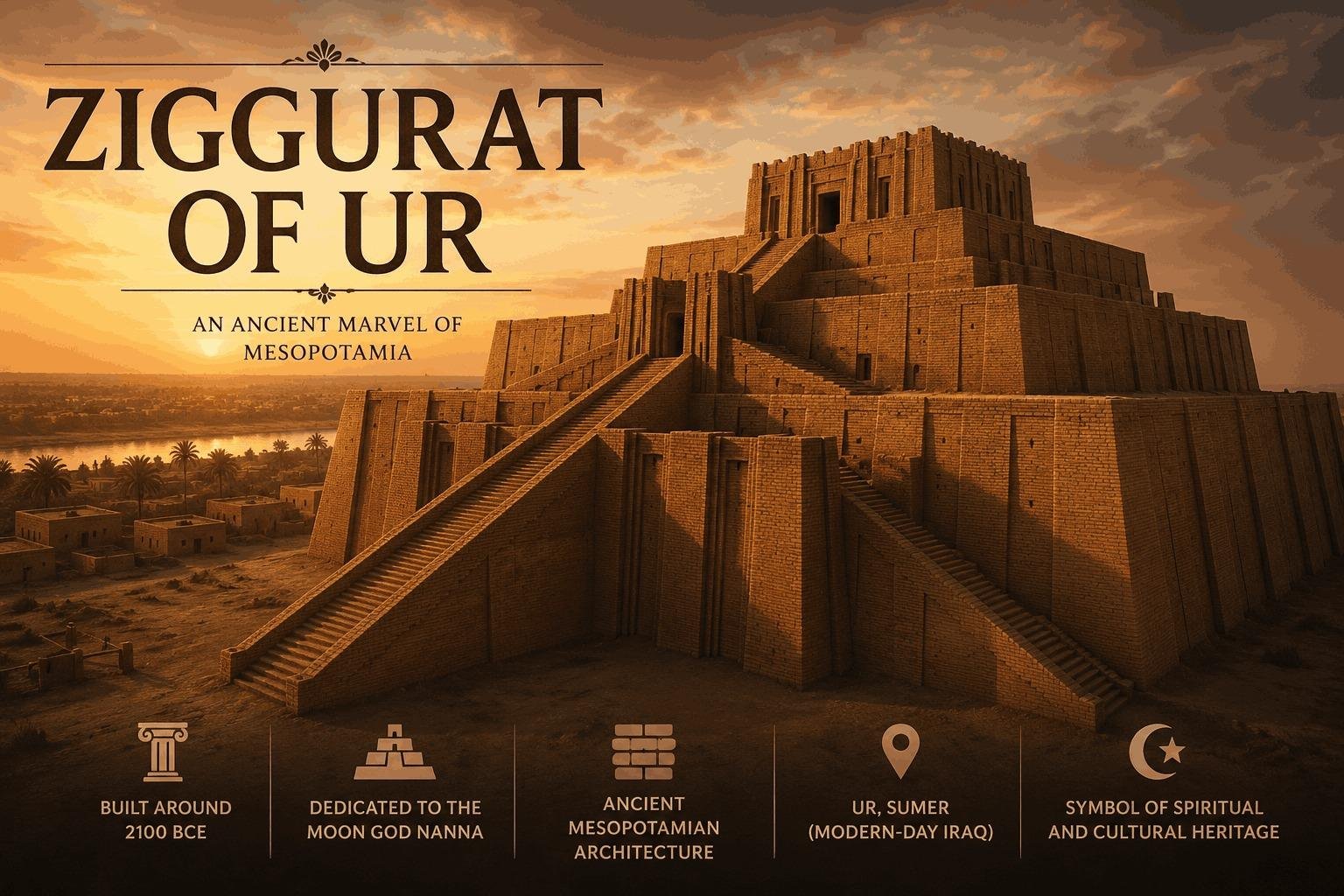
The Great Ziggurat of Ur is a massive stepped pyramid that served as the spiritual and administrative heart of the ancient city of Ur. Built in the 21st century BC, this structure was dedicated to Nanna, the Sumerian moon god. The Sumerians called it Etemenniguru, meaning “house whose foundation creates terror” or “temple whose foundation creates an aura.” Unlike Egyptian pyramids, the Ziggurat of Ur features tiered levels designed to bring worshippers closer to the heavens.
Who Built the Great Ziggurat of Ur?
King Ur-Nammu of the Third Dynasty of Ur initiated the monumental project around 2100 BC. He dedicated this massive structure to Nanna, the patron god of his city. His son, King Shulgi, completed the construction after his father’s death. The undertaking demonstrated the king’s piety and the vast resources at his command. This royal project transformed Ur into a major religious and political center.
The Architecture of the Ziggurat of Ur
The Ziggurat of Ur originally measured 64 meters long, 45 meters wide, and over 30 meters high. It sits on a massive rectangular base oriented to true north.
Key design features included:
- Three monumental staircases: One central and two side staircases converged at a gate on the first terrace.
- Three tiered terraces: These supported a temple dedicated to Nanna at the top.
- A solid mud brick core: The structure was solid, containing no chambers.
- A baked brick facing: The exterior used burnt bricks held together with bitumen, a natural tar. Over 720,000 such bricks were used for the lower terrace alone.
The architects incorporated clever features like weeper holes to drain moisture from the core, preventing the mud brick interior from swelling.
The Religious Significance of the Ziggurat
The structure was more than architecture; it was a bridge between heaven and earth. The temple at the top was considered the earthly home of the god Nanna. Worshippers believed that climbing the ziggurat brought them closer to the divine. The site also functioned as a center for economic redistribution. People would bring agricultural surplus to the temple and receive food allotments in return. To visit the ziggurat was a quest for both spiritual and physical sustenance.
The Rediscovery and Excavation
British archaeologist William Loftus first rediscovered the ruins in 1850. However, the most extensive excavations occurred in the 1920s and 1930s. Sir Leonard Woolley led a joint expedition by the University of Pennsylvania Museum and the British Museum. Woolley’s team meticulously uncovered the Ziggurat of Ur and the surrounding royal tombs, bringing the ancient Sumerian world back into the light.
The Restoration by Saddam Hussein
In the 1980s, Saddam Hussein ordered a partial reconstruction of the Ziggurat of Ur. Workers rebuilt the lower façade and the monumental staircases using modern baked bricks. In an interesting historical parallel, many of these bricks were stamped with the names of Saddam’s officials, mimicking the ancient practice of stamping bricks with a king’s name.
Modern History and Preservation
The Ziggurat of Ur has faced challenges in recent decades. During the Gulf War in 1991, the site sustained damage from small arms fire and explosions. Four bomb craters exist nearby, and over 400 bullet holes mar the structure’s ancient walls. Despite this, the ziggurat remains the most well-preserved of its kind in the world, second only to the Elamite complex at Chogha Zanbil in Iran.
The Cultural and Economic Importance of Ur
For the people of Dhi Qar Province, the Ziggurat of Ur is a source of immense pride. It symbolizes Iraq’s great history and serves as a potential economic driver through tourism. “To think of the amount of effort required to build the temple over 4,000 years ago and the sense of community and spirituality required to organize a project of this magnitude is overwhelming,” said one U.S. Army major stationed near the site. However, ongoing conflict has deterred visitors, costing the local economy significant revenue.
Visiting the Ziggurat of Ur Today
The site is located near the modern city of Nasiriyah in Iraq’s Dhi Qar Province. Travel to the region requires careful planning due to the security situation. Those who do visit can see the massive structure and the remains of the ancient city of Ur. The site includes the Royal Mausolea and the Palace of Ur-Nammu. It is believed that only 20% of the complex has been excavated, leaving much still buried under the sand.
The Legacy of the Sumerian Monument
The Ziggurat of Ur has left an indelible mark on human imagination. Many scholars believe it influenced the biblical story of the Tower of Babel. Its stepped design and function as a gateway to the gods echo throughout religious and architectural history. It stands as a testament to the innovation and spirituality of the Sumerians, the world’s first great civilization.
Frequently Asked Questions
Where is the Ziggurat of Ur located?
The Ziggurat of Ur is located near Nasiriyah in the Dhi Qar Province of southern Iraq. It sits on the site of the ancient city of Ur.
Why was the Ziggurat of Ur built?
King Ur-Nammu built the ziggurat to honor Nanna, the moon god and patron deity of the city of Ur. It served as a temple and an administrative hub.
How old is the Ziggurat of Ur?
Construction began in approximately 2100 BC, making the structure over 4,000 years old.
Can you visit the Ziggurat of Ur?
Yes, the site is open to visitors, but travel to Iraq requires careful security considerations. The site itself is under the supervision of a local curator.
Who excavated the Ziggurat of Ur?
Sir Leonard Woolley led the major excavations of the ziggurat in the 1920s and 1930s. The site had been noted earlier by other explorers in the 19th century.
Conclusion
The Ziggurat of Ur remains a powerful symbol of ancient achievement, a direct link to the dawn of civilization. Its surviving terraces are a testament to the faith and labor of the Sumerian people. While the site has faced the ravages of time and conflict, its significance endures. This monument teaches us about the origins of urban life, religion, and architecture. For those interested in history, a visit to this ancient wonder is an experience of a lifetime. Plan your journey to the Ziggurat of Ur to discover a piece of the world’s shared heritage. Explore our other articles on Mesopotamian history to continue learning.