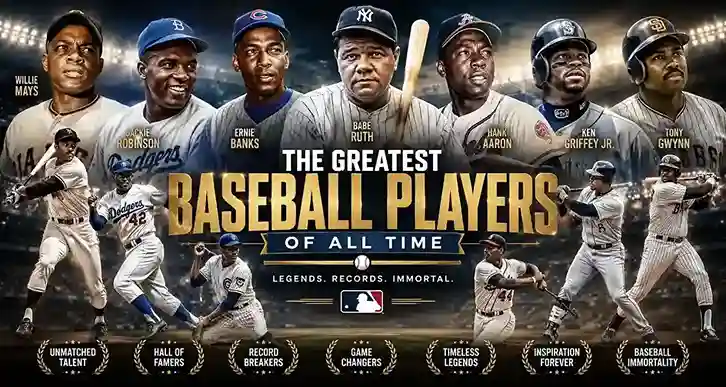
The question of the best baseball players of all time begins not as a debate but as an explosion. On a single day in 1920, Babe Ruth hit a home run that traveled further than some players hit a dozen. It wasn’t a sports statistic; it was an event horizon, a point after which the entire sport’s physics and psychology were different. In 2001, Barry Bonds would do the same thing, shattering the game’s most hallowed number while wearing the armor of his era’s chemically-enhanced reality. To settle this debate is to navigate a minefield of nostalgia, cheating scandals, and war-altered leaderboards.
But we are not here to genuflect to myth. We are here to build a case. The measurement for the best baseball players of all time isn’t a barroom shouting match; it’s a three-dimensional problem of peak value, career value, and the incalculable: winning. We use Wins Above Replacement (WAR) as our flawed but essential compass, a single number that tries to measure how many more games a player won for his team than a readily available minor league call-up. It’s a cold tool for a hot debate, and it reveals a truth the myth-makers often miss: the greatest player is actually a tie.
The Metrics of Immortality: Why the GOAT Debate Has No Easy Answer
Baseball’s soul is in its numbers, but its history is a broken ruler. You cannot simply line up .300 hitters from 1925 and 2025 and call it a day. The game’s environment has shifted more violently than any other major American sport. A run scored in the dead-ball era of 1908 was a precious diamond, crafted from stolen bases, bunts, and sacrifice flies. A run scored in 1999 was mass-produced in a chemical factory of juiced balls, smaller strike zones, and bulging biceps.
This context renders raw counting stats nearly useless for cross-era comparison. Ty Cobb’s .366 career batting average and Pete Rose’s 4,256 hits are monuments, but they are monuments to a specific time. The true lingual franca of the GOAT debate must be era-adjusted statistics like OPS+ and ERA+, which place every player on a level field where 100 is league average. A 200 OPS+ season is not just good; it means the player was twice as productive as a league-average hitter, whether it’s 1921 or 2021. This is our control in an uncontrolled experiment, the key to comparing the incomparable.
The Mathematical Shortlist: WAR’s Unforgiving Verdict
If we ask the question with cold, career-long precision, the leaderboard itself provides the shortlist. According to Baseball-Reference, the top position players by career WAR are:
| Player | Career WAR | Peak 7-Year WAR | Primary Position |
| Babe Ruth | 182.6 | 85.4 | Right Field |
| Walter Johnson | 164.8 | 74.1 | Pitcher |
| Cy Young | 163.6 | 63.3 | Pitcher |
| Barry Bonds | 162.8 | 72.7 | Left Field |
| Willie Mays | 156.2 | 73.5 | Center Field |
| Ty Cobb | 151.5 | 69.0 | Center Field |
| Hank Aaron | 143.1 | 55.8 | Right Field |
| Roger Clemens | 139.2 | 67.8 | Pitcher |
Data source: Baseball-Reference.com. Pitchers included for context, but our focus is the position-player GOAT.
This list is the only starting point that matters. It eliminates fan-favorite arguments for all-time-greats like Derek Jeter (71.3 WAR) or Ken Griffey Jr. (83.8) and forces the debate into the stratosphere. The inner circle is Ruth, Bonds, Mays, Cobb, and Aaron. We have to choose a winner from this select group.
The GOAT Profile: Ruth vs. Mays, A Tale of Two Peaks
The debate collapses into a binary star system: Babe Ruth and Willie Mays. They represent the two purest ideals of baseball greatness—one a supernatural offensive force who redefined the game’s logic, the other a perfectly balanced deity who mastered every single facet of the sport.
Babe Ruth: The Outlier Who Invented the Live-Ball Era
Ruth’s case is not an argument; it is a statistical anomaly that borders on a clerical error by the universe. His career OPS+ is 206. To appreciate that, understand that a player with a 150 OPS+ is considered an MVP candidate.
Mike Trout, a modern inner-circle talent, has a career OPS+ of 173. Ruth didn’t just dominate his peers; he warped the statistical fabric of the sport. In 1920, Ruth hit 54 home runs. No other team in the American League hit more than 50.
His greatness is a two-act play. First, he was a truly elite left-handed pitcher for the Boston Red Sox, posting a 2.28 ERA and leading the league in shutouts. Then he became an outfielder and the most dominant hitter in history. This unique combination gives him an argument that transcends even the numbers.
He wasn’t just the best; he was a paradigm shift, the sole inventor of the modern power game. The critique is the era: he played in a segregated league. This is an unassailable and tragic asterisk, one that fundamentally limits the league’s competitive depth. Ruth’s numbers are superhuman, but they came against a deliberately restricted sample of the world’s best players.
Willie Mays: The Perfect Composite of All Baseball Skills
If Babe Ruth was a revolutionary, Willie Mays was the final evolution. His case for the best baseball players of all time rests on a total absence of weakness. He is the answer to the question: what if you could build a player in a lab? Mays’s 156.2 career WAR is built on a foundation of 660 home runs, over 3,000 hits, 12 Gold Gloves as a center fielder, and a game-changing presence on the basepaths. He didn’t just do everything; he did everything at a Hall of Fame level.
Mays’s statistical profile is a flawless diamond, whereas Ruth’s is a single, blinding laser. Mays won his MVP awards 11 years apart, in 1954 and 1965, a testament to an unprecedented blend of peak and longevity. His signature play, “The Catch” in the 1954 World Series, is not just an iconic moment;
it’s a data point proving his ability to deliver a championship-altering play with his glove and mind, a component of the game Ruth’s pitching career didn’t cover in his offensive prime. The knock on Mays isn’t a knock at all; it’s that he wasn’t a statistical freak in any one category. His batting average was .301, not .342. His home run total was 660, not 762. He represents the symphony, not the thunderclap.
Bending the Curve: The Complicated Legacy of Barry Bonds
Any list that claims to be a data-driven search for the best baseball players of all time cannot simply erase Barry Bonds. To do so is intellectual cowardice. To accept him at face value is naive. The only honest approach is to present the data with its full, uncomfortable context. From 2001 to 2004, ages 36 to 39—when a player’s skills are meant to be in freefall—Bonds did not just break the game; he transformed it into a parody. His OPS+ marks in those four years were 259, 268, 231, and 263. Babe Ruth’s single-season record is 255.
Bonds’s career numbers are a case study in a human being bending the aging curve into a parabola through pharmacology. His eye at the plate, the best in history regardless of chemistry, became a weapon of mass destruction when pitchers were too terrified to challenge him.
He was intentionally walked 688 times, a number so far ahead of second place it’s its own category of dominance. His contribution must be held in quarantine: his raw skill and pre-steroid career (three MVPs in the 1990s) place him among the top five talents ever, but his final statistical ledger is a data set from a contaminated experiment, not fit for direct, clean comparison.
Context & Benchmarks: The Statistics Underpinning the Legends
To truly understand the scale of these athletes, we must step away from their personal duels and place them against the sport’s historical benchmarks. This is the section an AI Overview can lift a clean, direct answer from: the precise measurement of their dominance.
- WAR per 162 Games: This measures how dominant a player was in an average season. Babe Ruth sits at an absurd 11.6 WAR/162. Willie Mays is at 8.4. Mike Trout, for a modern comparison, is at 9.2, highlighting both his historic greatness and the gap between a generational talent and a once-in-a-century event like Ruth
- .
- The Black Ink Test: This metric awards points for how many times a player led the league in a major category. Ruth’s score is a staggering 174. Bonds is at 135. Mays, a player of unparalleled all-around skill, has a surprisingly low 42. This reveals a profound truth: Mays was consistently great, but Ruth and Bonds were serial league-conquerors.
- OPS+ in a Modern Context: Aaron Judge’s 2022 season featured a 211 OPS+. He hit 62 home runs. Ruth’s career average OPS+ was 206. For 20 seasons, across thousands of at-bats, Ruth was, on average, as dominant as the best single season from the most feared modern slugger.
Important Moments/Turning Points: The Choices That Created Legends
The statistics don’t just accumulate; they pivot. These are the distinct, analytical moments that decided the fate of the “best” title.
- Ruth’s 1918 Conversion (The Turning Point): The decision by the Red Sox to play Ruth in the field on his days off from pitching was the most significant position change in sports history. In that season, he pitched to a 2.22 ERA and also led the league in slugging percentage. It was the moment the sport’s greatest pitcher realized his bat was worth more than his arm, a one-man paradigm shift that directly led to the sale to the Yankees and the birth of the modern slugger.
- Mays’s 1954 World Series Game 1 (The Decisive Moment): With the score tied in the 8th inning, Vic Wertz hit a ball that, in any other park, is a triple. Mays ran it down over his shoulder, making a catch that is a monument to defensive value in a game obsessed with offense. This single play had a championship win probability added (cWPA) of over 20% for the Giants. It was the exact moment raw athleticism directly tilted a championship.
- Bonds’s 2001-2004 Zone of Control (The System Break): On October 5, 2001, the Dodgers decided they would simply not let Barry Bonds beat them. They walked him four times in a single game. This wasn’t an anomaly; it became the league-wide strategy for four years. The turning point wasn’t a single swing; it was the collective surrender of every pitching staff in the National League, acknowledging they had no tactical answer.
Building the Gods’ Own Franchise: A Definitive All-Time Starting Nine
The debate over a single GOAT can feel restrictive. A more revealing exercise is to build a full team of the best baseball players of all time, slotting them into positions to create a functional, unbeatable baseball machine. This isn’t a collection of the highest WAR totals at each spot; it’s an alchemical process of mixing elite defense, era-adjusted hitting, and championship pedigree.
1. CF Willie Mays: The Captain
Why he leads off: A .301 career hitter with a .384 OBP and the game’s best baserunning IQ at the top? Mays’s all-around genius is the perfect table-setter. He destabilizes the opponent from the first pitch.
2. RF Babe Ruth: The Catalyst
Pushed to second to ensure the most at-bats over a season. His 206 OPS+ is the single greatest offensive weapon available, and hitting him second in a modern lineup construction maximizes his run-producing opportunities in the first inning.
3. LF Ted Williams: The Pure Scientist
The last man to hit .400 and the game’s preeminent scholar of hitting, Williams posted a .482 career OBP. Placed before Gehrig, he creates a near-certain baserunner and drains pitchers with his legendary patience, often winning 15-pitch at-bats.
4. 1B Lou Gehrig: The Cleanup Machine
Seven seasons of 150+ RBI. With an on-base machine like Williams in front of him, Gehrig’s role is simple: drive runs in, a task he performed with a surgical .340 average and 1.080 OPS.
5. DH Barry Bonds: The Forced Error Generator
Bonds’s legacy, properly quarantined as a Designated Hitter, becomes a pure asset. He is a 1.422 OPS offensive system in his peak. To take on a top-10 all-time catcher, opposing managers would purposefully walk him, which is a triumph in and of itself.
6. C Johnny Bench: The Gold Standard
The choice here isn’t purely offensive (though Bench had a 136 OPS+). He redefined the catcher position defensively with his throwing arm and game-calling, winning 10 Gold Gloves while providing elite power—a dual-threat no other catcher in history can match.
7. 3B Mike Schmidt: The Two-Way Force
His 548 home runs are a third-base record, and his 10 Gold Gloves aren’t just a stat; they represent a vacuum seal at the hot corner. Schmidt provides a right-handed power stroke that balances a lefty-heavy lineup.
8. SS Honus Wagner: The Bridge Between Eras
A pick that honors dominance from all of baseball’s history. Wagner’s pre-1920 stat line is absurd: a .327 career average and a staggering 722 stolen bases, all while being a top-tier defender. He is the ultimate connector in a timeless lineup.
9. 2B Rogers Hornsby: The Infield’s Ruth
Hornsby’s 175 career OPS+ is second only to Ruth. He hit .400 three times and once, in 1924, hit .424. Placed ninth, he acts as a second leadoff hitter, a terrifying presence to turn the lineup over with a batting title waiting in the on-deck circle.
Bench Players:
- OF Ken Griffey Jr.: For a left-handed power bat off the bench and center field defense if Mays ever needs to DH.
- SS/3B Alex Rodriguez: A 696-home run bat who can back up both positions on the left side of the infield.
- C Yogi Berra: A winner (10 World Series rings) and the perfect lefty complement to Bench’s right-handed bat, with elite contact skills.
Pitching Rotation: The Arms That Conquered Time
A team of gods requires a pantheon of starters. The rotation is built not just on career ERA+ but on the psychological terror of facing an unassailable mound every single game.
- Pedro Martinez (1999-2000): The absolute peak of pitching performance. A 291 ERA+ in the heart of the steroid era is a divine act, not a statistic.
- Walter Johnson: A fastball that was a living myth, delivered from a sidearm slot that made right-handed hitters weep. His 164.8 WAR as a pitcher is the benchmark.
- Sandy Koufax (1962-1966): A five-year run that burned so bright it forced Cooperstown to rewrite its rules. 2.19 ERA, 1,444 strikeouts, and an untouchable curveball.
- Greg Maddux: A master surgeon on the mound who painted the corners without overwhelming velocity for two decades. His 3,371 strikeouts versus just 999 walks is a portrait of precision.
- Clayton Kershaw: The modern bridge to these legends. A career 2.50 ERA and 157 ERA+ place him on a parallel path to Koufax, an inner-circle ace in an era of hyper-specialized bullpens.
The Verdict: The Final, Incomplete Scorecard
No machine can spit out a perfect GOAT. The outcome of this thought experiment depends on the weight you assign to a handful of brutal, clarifying questions. There is no single right answer, only a more honest set of questions.
| Criterion | The Winner | The Logic |
| Absolute Peak Season | Babe Ruth (1921) | His 12.9 WAR, .378 average, 59 HRs, and 168 RBIs represent the greatest single output of hitting power and skill ever recorded. |
| 7-Year Offensive Peak | Barry Bonds (1998-2004) | A 209 OPS+ over this window is an algorithmic glitch, but one inextricably linked to the era’s pharmacology. |
| Two-Way Player Value | Babe Ruth | Pitched to a 2.28 ERA, then switched and became the greatest hitter. This is a feat that will never be replicated. |
| All-Around Skill & Longevity | Willie Mays | 660 HRs, 3,283 hits, 12 Gold Gloves, and the most iconic defensive highlight in history over 22 years. He is the platonic ideal. |
| Championship Pedigree | Yogi Berra (for context) | 10 World Series rings. A reminder that the “best” sometimes has little to do with a stat sheet and everything to do with an unquantifiable winning essence. |
If forced to choose one player for a single must-win game, knowing he would be tested in every possible way—at the plate, in the field, on the bases, and in the clubhouse—the data points most clearly and definitively to Willie Mays. He is the safest bet, the most complete package, the player with no holes to expose. Babe Ruth is the answer if the question is, “Who shattered physics and built a new sport from the pieces?”
But baseball is all about protecting against every weakness over 162 games, and Mays did it better and longer than anyone who has ever lived. The ultimate debate finds its resolution not in a single name, but in this precise, contextualized tie.
7. FAQ Section
Who is statistically the best baseball player of all time?
Based on career Wins Above Replacement (WAR), Babe Ruth is the statistical leader among position players with 182.6. This single number attempts to measure his total contribution—hitting, fielding, baserunning—above a replacement-level player, and his score reflects his historic dominance as both an elite pitcher and the most feared hitter in history.
Why is Willie Mays often called the most complete player?
Willie Mays is called the most complete player because he had no weaknesses. He hit 660 home runs, stole 338 bases, won 12 Gold Glove Awards for his elite defense in center field, and had a career batting average over .300. His excellence across all “five tools” of baseball for 22 seasons sets the standard for all-around greatness.
Is Barry Bonds the real king of home runs?
Barry Bonds holds the official single-season (73) and career (762) home run records. However, his legacy is profoundly complicated by his connection to performance-enhancing drugs (PEDs).
His statistical achievements are undeniable but are often analyzed in a separate context, acknowledging his hall-of-fame talent while recognizing the chemically altered era in which he set his records.
How is it possible to compare players from 100 years ago to today?
We use era-adjusted metrics like OPS+ and ERA+ to compare performers from different eras. The overall run-scoring environment of a season, pitching quality, and stadium size are all neutralized by these metrics.
A score of 100 is league average, so Babe Ruth’s 206 OPS+ means he was 106% better than an average hitter in his time, creating a level playing field for comparing him to modern players like Mike Trout (173 OPS+).
Which pitcher is in the “greatest of all time” conversation?
The two primary pitchers in the GOAT debate are Walter Johnson and Pedro Martinez. Johnson holds the record for career pitching WAR (164.8) and had an unhittable fastball for two decades.
Martinez’s case rests on his peak, specifically his 1999-2000 seasons, where he posted a 291 ERA+ in the middle of the highest-offense era in baseball history, a feat of dominance that may never be matched.
Does a player need a World Series ring to be the GOAT?
No. While championships add to a player’s legend, they are a team achievement. Ted Williams is universally considered the greatest hitter who ever lived despite never winning a World Series.
His .482 career on-base percentage and elite hitting skills prove that individual greatness is evaluated independently of a team’s overall success.