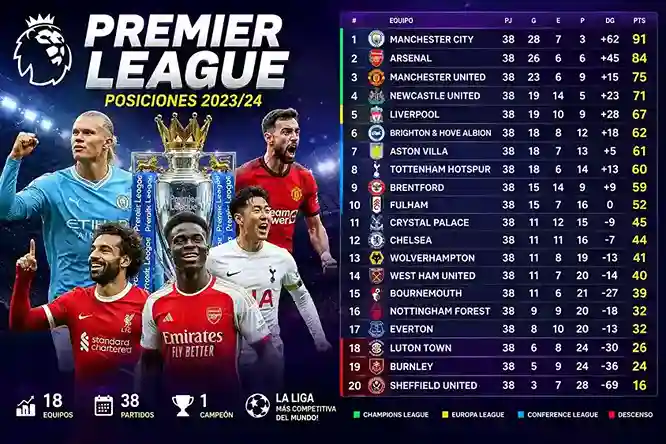
You want the raw table. Not a three-paragraph story about the weather in Manchester. You opened this page to see exactly which club leads the pack, who dropped points last weekend, and what the numbers mean for the title race, European spots, and the relegation scrap. I track these posiciones de premier league shifts every matchday because a single goal doesn’t just change a scoreline, it redraws the entire season’s power map.
Reading the Premier League Table Without the Noise
A league table looks simple. Twenty names stacked vertically. But every column holds a story beyond the points. You need to scan it like a scout.
The first number you check is P (matches played). Teams rarely stay synchronized here. A club might sit comfortably in 6th, but a glance at their games-in-hand column either signals a hidden surge or a trap of unplayed tough fixtures.
Goal Difference (GD) acts as a tiebreaker. It often decides titles and final relegation spots. A +35 tells you a side dominates; a -25 screams defensive emergencies. Look at GF (goals for) and GA (goals against) separately. High GF with high GA means glorious chaos. A relegation spiral could result from 1-0 losses due to low GF and low GA.
The Form column, available on deeper stat sites like the official Premier League page, exposes momentum. Five green Ws point to a club peaking. A scattering of red Ls reveals a dressing room under pressure.
| Table Column | What It Really Tells You |
| P (Played) | Match rhythm and potential games in hand advantage. |
| W/D/L | Consistency level. Too many draws kill title bids. |
| GF/GA | Attacking firepower versus structural fragility. |
| GD | True performance gap. More reliable than points early on. |
| Points | The final currency. 3 for a win rewards risk-taking. |
The Title Race: Control and Collapse
Winning the Premier League demands a 90-point pace. Any slip before Christmas plants doubt. You see the top two posiciones de premier league separated by a single point, and suddenly every pass in a Tuesday night fixture carries enormous weight.
A frontrunner builds their lead through controlled possession and a ruthless final third. They strangle mid-table sides by scoring early, forcing the opposition to open up, then killing the game on the counter. Their matches rarely look panicked.
The chaser relies on momentum. They win five straight in November, and the pressure shifts. The team at the summit knows one draw gifts the chaser a path to leapfrog them. You track this chase not through headlines but through expected goals (xG) in tight away matches. When the chaser starts winning 2-0 at notoriously stingy grounds, the lead at the top becomes a highly stressed cushion.
Fatigue from European nights cracks momentum. A thin squad facing three games in seven days rarely keeps clean sheets. Squad depth enters the table analysis. A leader with a healthy bench survives January; a leader relying on the same eleven collapses after a muscular midfield injury.
The Battle for Top Four: Risk and Reward
Finishing among the top four posiciones de premier league rewrites a club’s financial future. Champions League qualification pulls top talent, justifies higher wage structures, and protects star players from transfer interest.
The fight gets bloody from third down to sixth. You see a group of three clubs jammed within a four-point range, each playing a different style. One pressures high, outraces defenders, and forces turnovers in the opponent’s half. Another sits deep, absorbs pressure, and steals wins through a set-piece specialist who scores eight headers a season.
Champions League Odds via Positioning:
- 3rd Place: Automatic group stage entry. Recruiting leverage spikes. Pre-season tours book bigger venues.
- 4th Place: Automatic group stage entry but nail-biting until Matchday 38. Often decided by goal difference.
- 5th Place (conditional): Europa League default unless coefficient awards an extra UCL spot.
Clubs chasing top four scrutinize the remaining fixture list. Five of the last eight against bottom-half teams? That’s a smoother runway. A run of away matches against direct rivals? That turns the dressing room into a high-stakes chess match.
A single missed penalty in April can shift a club from 4th to 5th, costing them roughly £50 million in guaranteed revenue. You watch these matches knowing the tension is financial, not just sporting.
The Relegation Zone: Pressure That Tests Every Fiber
The bottom three posiciones de premier league chew up managers, destroy confidence, and permanently alter club trajectories. Dropping into the Championship slices broadcast revenue by over £100 million in parachute payment differential.
You spot relegation candidates not just by points but by defensive patterns. A team conceding from crosses week after week shows a systemic defensive failure, not bad luck. Another might dominate possession against mid-table sides yet lose 2-1 repeatedly, a sign of no cutting edge and a soft underbelly under pressure.
Early Warning Signs:
- Zero clean sheets in the opening ten matches.
- Reliance on a single goal scorer who hasn’t signed a new contract.
- Public friction between a manager and a sporting director.
Clubs often chase survival by switching to a pragmatic, low-block system. They scrap intricate buildup play for direct balls to a physical striker. The gamble works when a team strings together three 1-0 home wins in March against fellow strugglers. It backfires when the direct approach gifts possession to technical opponents who then slice them open.
Spring arrives, and the 17th-placed team celebrates survival like a trophy. The players, drenched in sweat after a 0-0 draw on the final day, know exactly what their defensive block just saved.
How the Schedule Shapes the Shifting Table
You can’t judge posiciones de premier league accurately without examining the fixture list. The table lies when teams have played uneven schedules.
A club sitting 8th with two games in hand on 6th place controls its own climb. But games in hand aren’t free points. If those unplayed fixtures are away at title contenders, those extra matches become a burden, not a bonus. Fatigue stacks. Yellow card suspensions accumulate. The table advantage becomes a trap.
The Christmas and New Year pile-up is the most revealing stretch. Four league games in under two weeks test every squad. Rotation becomes mandatory. You see a team that looked sharp in November suddenly ship seven goals across two matches because the third-choice left-back can’t handle a top winger. These December results permanently tilt the table positions.
International breaks arrive in autumn, and some clubs return battered. A South American striker travels 12,000 miles, plays a qualifier at altitude, returns on Thursday, and starts a Premier League match on Saturday. His performance drops. The team drops points. The table doesn’t explain the travel fatigue behind those dropped points.
Advanced Statistics That Explain the Standings
Points show outcomes. Statistics uncover future outcomes. Smart fans read the table through metrics that predict where clubs will finish, not just where they currently sit.
xG (Expected Goals): Quantifies chance quality. A squad that is significantly surpassing their xG is on a hot finishing streak that could slow down. A team underperforming its xG but creating consistently might be poised to climb the posiciones de premier league once finishing regains its normal level.
xGA (Expected Goals Against): Reveals defensive openness. A club with low points but low xGA likely suffers from poor finishing luck or an individual goalkeeper error. A club with decent points but terrible xGA concedes too many chances and expects a correction downward.
PPDA (Passes Per Defensive Action): Measures pressing intensity. Elite sides often post low PPDA numbers, meaning they hassle opponents immediately. When a promoted side tries to press high against a technical giant, the PPDA might look similar, but the giant slices through the press while the minnow gets exposed.
Shot-Creating Actions: Tracks the live-ball actions directly leading to a shot. A midfielder who ranks top-five in this metric drives his team’s attack even if his direct assists stay low. His presence lifts the club up the standings through constant threat creation.
These numbers interpret the table honestly. A team sitting 14th in points but 8th in expected goal difference triggers close monitoring for an upcoming surge. The data screams that their current standing doesn’t match their performance level.
Key Metrics vs. Table Accuracy:
| Metric | Tells You |
| xG Difference | True performance level behind the points total. |
| Big Chances Missed | Finishing waste. Often corrects positively or negatively. |
| Clean Sheet % | Defensive reliability. Directly correlates with top-half finish. |
| Points from Losing Positions | Mental resilience. Marks a side hard to beat. |
Key Transfers and Their Direct Table Impact
A winter signing can yank a club up the standings. You measure transfers not by the fee but by the immediate change in posiciones de premier league for the buying club.
A striker arrives from a European league. Within three games, he adds goals that the previous forward missed. The club gains six points from draws-turned-wins. The table shifts from 13th to 9th. The move doesn’t just add goals; it reduces pressure on the defense, which stops conceding late equalizers because the team now leads comfortably.
A central defender joins a leaky backline. The clean sheets start stacking. The goal difference climbs out of negative territory. That repair job alone can move a team five places up the final rankings.
Transfer Types That Change Rankings:
- Clinical Finishers: Turn 0-0 frustrations into 1-0 victories.
- Midfield Anchors: Protect back four, snuff out counters, let creatives roam.
- Commanding Center-Halves: Organize set-pieces, win aerial duels, reduce xGA.
Selling clubs suffer the reverse. A star playmaker leaves in January without a replacement ready. The attacking output collapses. The team slides from European contention into mid-table safety mode. The table reflects the hole left behind.
Tactical Systems That Produce Top Positions
Tactical identity shapes the top posiciones de premier league. You see clear systems that separate the top four from the scramble below.
The High-Pressing, Possession System requires technically superior center-backs comfortable on the halfway line. The full-backs pinch into midfield to overload the center. The forwards press immediately upon losing the ball. This system suffocates weaker teams and racks up huge goal differences when the press forces errors in dangerous areas.
The Transition-First System concedes some control to explode forward. A team sits in a compact mid-block, wins the ball, and launches rapid vertical attacks. Wingers sprint into channels. The striker makes diagonal runs. This system thrives against possession-heavy opponents who leave space behind their high line.
The Set-Piece Specialists build their season around dead balls. They hire specialized coaches, design complex blocking schemes, and target specific weak defenders. When a team scores 15+ set-piece goals, they steal points from matches where open play created nothing. This efficiency can push a mid-table squad into a European slot.
A manager’s in-game tactical shift also reshapes the table. Trailing at halftime, a coach switches from a back four to a back three, adds a second striker, and completely flips the match’s momentum. These tactical recoveries add up. A club that collects 20+ points from losing positions demonstrates superior strategic adaptability, a trait that solidifies high standing.
Goalkeeping and the Points They Save
An elite goalkeeper alters the table single-handedly. You watch a relegation-threatened side survive purely because their shot-stopper delivers an outstanding campaign.
Post-Shot Expected Goals (PSxG) measures whether a keeper prevents shots that should have gone in. A keeper who consistently outperforms his PSxG essentially erases defensive mistakes. His saves convert expected losses into draws and expected draws into wins.
A top goalkeeper organizes the penalty area, claims crosses, and projects calmness that reduces defensive panic. That calmness prevents the cascade of errors that sends teams toward the bottom three. When that keeper misses a month through injury, the backup concedes soft goals, and the team drops four places in four weeks. The direct correlation between a starter’s presence and points proves goaltending’s positional impact.
Managerial Pressure Cooker and Table Consequences
A manager sacking reshuffles posiciones de premier league almost instantly, but the bounce effect isn’t guaranteed.
A new coach arrives with fresh tactical instructions, often shifting to a simpler defensive structure first. The team grinds out a clean sheet. Confidence trickles back. A mid-season switch from zonal marking to man-marking on set-pieces can stop the flow of cheap goals, converting defeats into points immediately.
But a caretaker without tactical clarity creates confusion. The attacking patterns dissolve. Players look around for instructions that never come. The team slides from 15th into the bottom three. The choice of replacement determines whether the club stabilizes or spirals.
Long-term managers build systems that withstand injuries and fixture congestion. Their players understand their roles without thinking. This institutional knowledge generates consistent standing. Sacking a long-serving manager often results in a drop before any rise, as the new system requires time the table race doesn’t permit.
Youth Academy Products Influencing the Senior Table
Academy graduates inject fresh energy into tired squads. A teenage midfielder with no fear dribbles past seasoned defenders and creates scoring chances that veteran teammates had stopped attempting.
These young players shift posiciones de premier league by providing squad depth at low cost. A club starting four academy graduates against a top-six opponent might lose experience but gains unpredictable movement and hunger. The opponent’s scouting report contains limited data on the youngster’s tendencies, creating a surprise factor that leads to early goals.
Academies that consistently produce first-team talent give their clubs a structural advantage. They avoid panic-buying average replacements in January. They maintain tactical continuity because the youth teams run identical systems to the senior squad. This pipeline stabilizes league position across seasons.
Stadium Atmosphere and the Home-Fortress Effect
A roaring home crowd pulls their team into higher placement. The data supports this. Home teams win significantly more often across a Premier League season, and the emotional lift during late pushes at a packed stadium generates points that cold analytics can’t predict.
Night matches under lights amplify this effect. A mid-table side hosts a title contender on a Wednesday evening. The crowd stays loud for 90 minutes. Every tackle, every clearance, every sprint earns a roar. The favorite starts making uncharacteristic passing errors. The underdog scores from a corner. The stadium erupts. Three points stay home.
Empty or quiet stadiums, by contrast, remove this edge. The table reflects this subtle shift. A club with a hostile, intimate ground builds a home record that fuels their final position. Visiting teams dread the trip. That dread translates into cautious football that the home side exploits.
Remaining Fixtures and the Final Table Prediction
Reading the season’s final chapter requires a fixture-by-fixture analysis. A club’s run-in determines final posiciones de premier league more than their current points total.
Look at the last six opponents for each team fighting for something. A title contender facing three of the bottom five in their last four matches has a clear path. A relegation battler facing four of the top six in their final five matches probably needs miracles.
Fixtures that Sink or Save:
- Back-to-back away matches against clubs fighting for the same objective (six-pointers).
- Final day hosting a team with nothing to play for (beach mindset opponent).
- A midweek trip to a physical, direct side followed by a weekend clash against a possession giant.
Clubs fighting relegation often target specific matches as must-win. They rotate heavily before a cup tie to rest starters for a more winnable league clash the following weekend. That calculated gamble, resting players, directly influences the survival arithmetic.
Data, Table Tracking, and Expert Sources
Sharp analysis depends on current data directly from those who live these numbers. For the latest shifts in the table and complete match results, the official Premier League website provides the definitive real-time table. Detailed statistical breakdowns that validate any underlying performance claims come from the Opta Analyst hub, where advanced metrics sit plainly without sensationalism. For reliable, investigation-backed transfer updates that directly affect squad valuations and projected table impacts, the BBC Sport Premier League section delivers consistently sourced reporting. These three outlets form a solid tripod of authoritative data, analytical depth, and trustworthy news.
Frequently Asked Questions About Premier League Standings
How often do Premier League standings refresh after a match?
The table updates instantly after the referee blows the final whistle. Official sources reflect the new posiciones de premier league within seconds, recalculating points, goal difference, and rank order immediately.
Can a team jump multiple spots in one matchday?
Yes. A 3-0 win combined with losses by the two teams directly above can lift a club from 8th to 6th, especially when goal differences sit tight. Premier League table positions swing dramatically on weekends with many head-to-head clashes.
What happens when teams finish level on points?
The tie is first broken by goal difference, followed by goals scored. If those match, head-to-head records between the tied clubs decide the final position in the Premier League. A playoff match settles a tie for a title, European spot, or relegation survival.
Why do some teams have games in hand?
Unmatched matchups result from postponements brought on by cup finals, bad weather, or other scheduling difficulties.These games mean the Premier League current position doesn’t yet reflect a club’s full potential point tally.
Does yellow card accumulation affect league position?
Indirectly. Suspensions from accumulated bookings remove key players from crucial matches, weakening the side and potentially dropping points, which negatively shifts league ranking over a Premier League season.
Where can I find the complete season table history?
The official Premier League site archives every final table. This data lets you compare historical Premier League final standings, track long-term club trajectories, and test how teams perform across different decades.
Your Final Whistle on These Standings
The table doesn’t lie when you know what hides behind the numbers. Every point gained or dropped reshapes a club’s tomorrow. You now hold the interpretive tools: reading fixture-load fatigue, spotting xG overperformance, and sensing where momentum truly sits. Which current position surprises you most? Drop your take below, because these rankings will shift again within days, and the conversation belongs to those who saw the movement coming.